Year: 2026

Commentary, COVID-19

Nine observations from carbon dioxide monitoring

Introduction

In the first year of the COVID-19 pandemic I learned that we can estimate our level of risk by checking the concentration of carbon dioxide in the air, because when infected people breathe out virus aerosols, they also breathe out CO2.  I recently wrote about some limitations on this technique, and tips for getting reliable information.

A carbon dioxide monitor reads 3208 parts per million, at 31 degrees Celsius and 48% relative humidity.  It is being held in a hand between bare knees in a commuter train car.

I’ve been checking carbon dioxide levels for over three years now, and I’ve started to see patterns.  I don’t have to keep checking the same places, because they have the same levels under similar conditions.  Today I charged my carbon dioxide monitor for the first time in weeks, because I’m flying on a plane for the first time in almost two years.

I’d like to share some of the things I’ve learned, so that you can benefit even if you haven’t been monitoring carbon dioxide on your own.

Outdoor air helps reduce the chance of passing on respiratory diseases

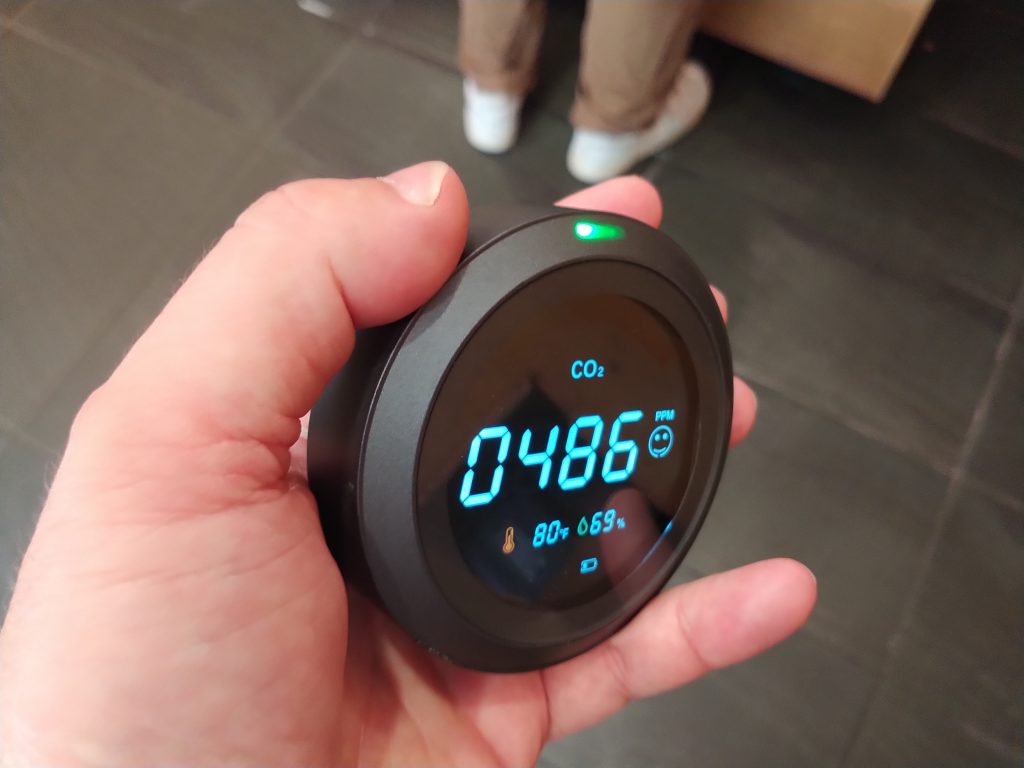
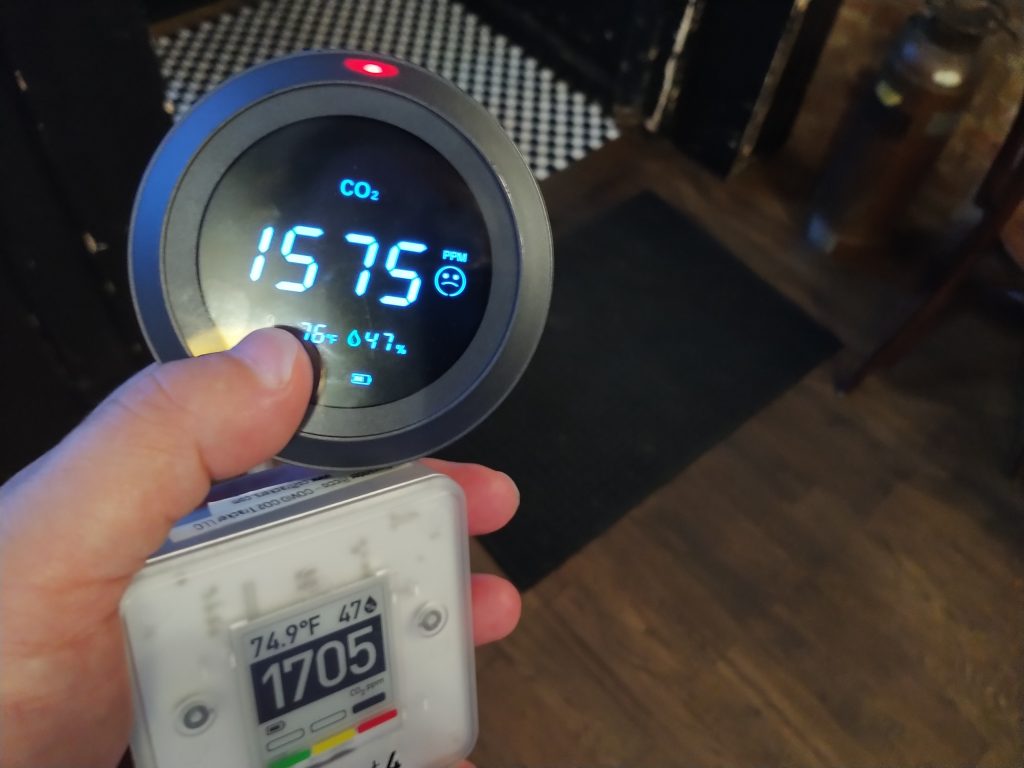
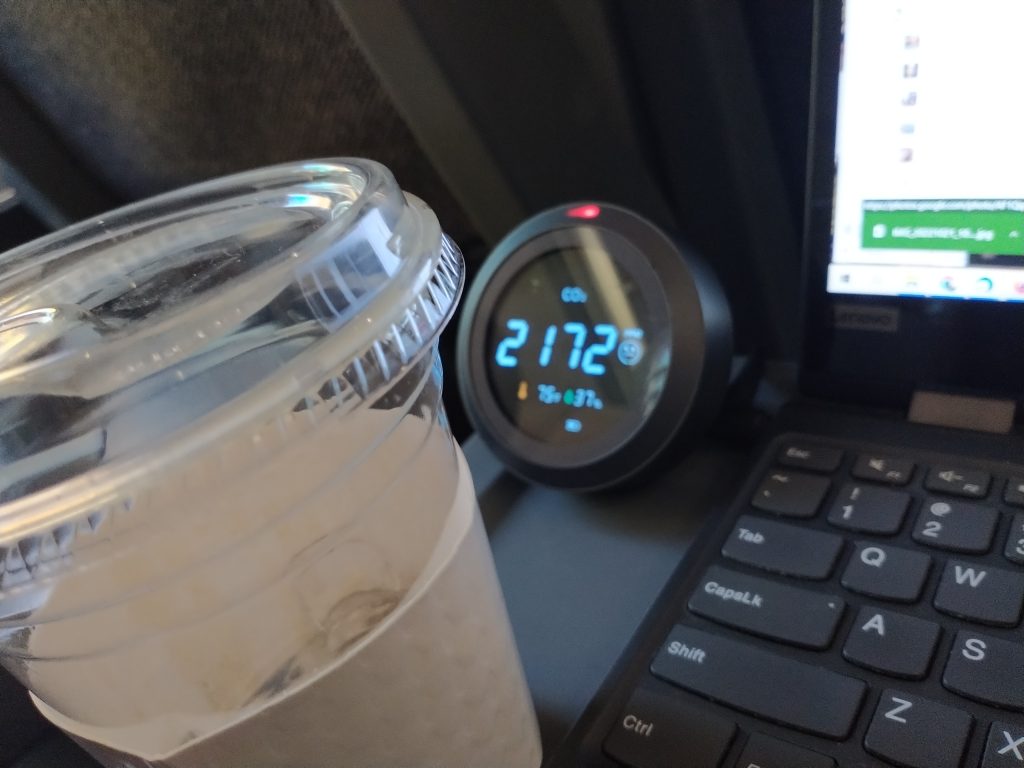
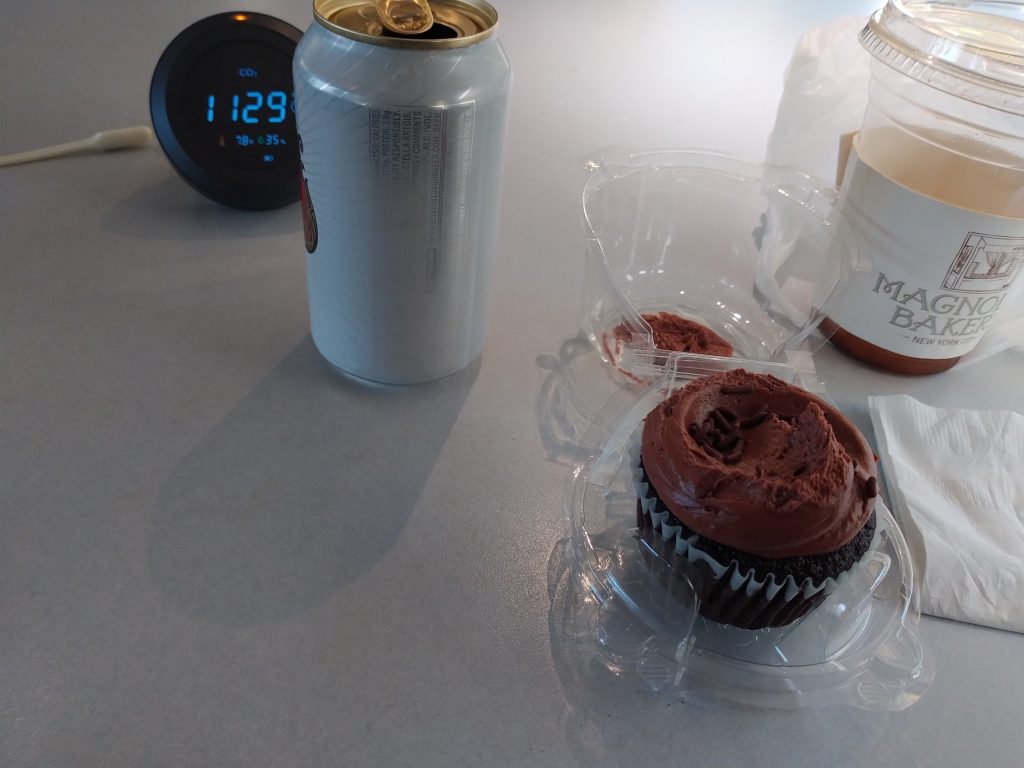
We’ve known this for over a century, but my readings have confirmed it.  I’ve been to at least two cafes on warm fall days when the front door is open, and gotten nice low carbon dioxide readings.  I came back a few weeks later when it was colder and the door was closed, and I wouldn’t have taken my mask off in there during an outbreak! The pictures above show the readings from one cafe with the front door open and closed.

It doesn’t have to be a door or a window that’s open.  A good ventilation system can exchange infectious air for cleaner outdoor air, or pass air through a filter that removes aerosols.  The facilities manager at my employer is very proud of the ventilation system he’s set up, and the measurements I’ve taken show generally low concentrations of carbon dioxide across campus.  I can feel the ventilation in certain hallways, like a stiff breeze.

After these observations, if I see that there’s a window or a door open in a cafe, or if I can feel a breeze in a hallway, I have a good guess that it’s relatively safe.  I might try to confirm it periodically, but I wouldn’t have to check it every time.

Speaking louder and breathing harder increases the likelihood of transmission

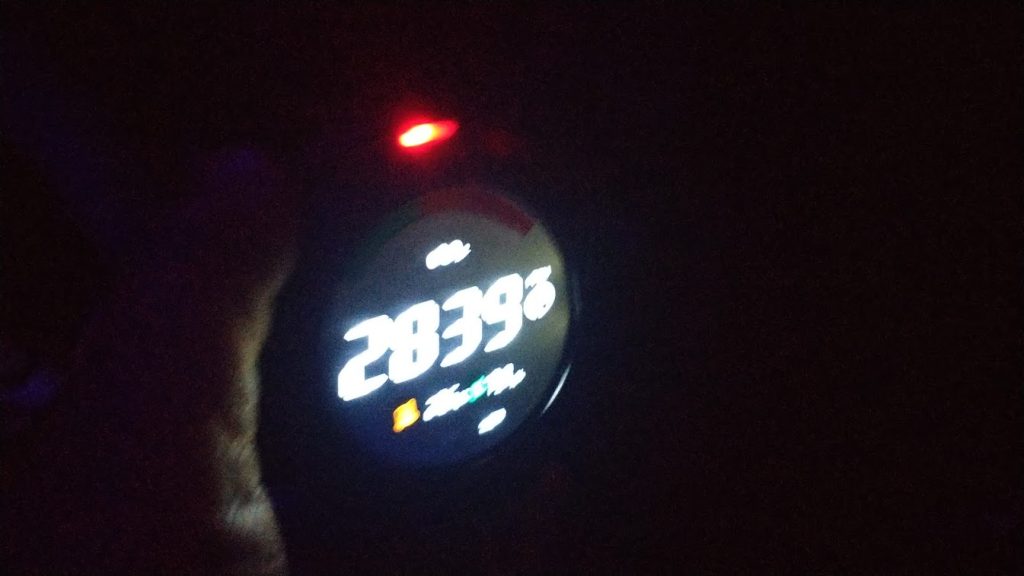
A carbon dioxide monitor in the dark reads 2839 parts per million.

In 2020 we heard about the unfortunate performers in the Skagit Valley Chorale who contracted COVID-19 from an infected choir member at a rehearsal, two of whom died.  Analysis, supported by other studies, showed that forceful singing and heavy breathing increase the chance of both transmitting and catching COVID and other infectious respiratory diseases.

This can be seen in the carbon dioxide levels I measured during more than one large professional meeting, where the CO2 levels increased dramatically after the audience cheered, despite the good ventilation. Also, when COVID transmission levels were low, I participated in a musical performance with lots of singing and measured one of the highest levels I’ve gotten.

This means that if COVID transmission levels are high and I know people are going to be speaking loudly or singing in an indoor space, I will avoid that space if possible.  If I can’t avoid it, I’ll wear a mask.

The level of crowding makes a difference

If I’m sitting quietly in a room by myself, or maybe with one or two other people, and there’s halfway decent ventilation, I’ll see carbon dioxide concentrations that aren’t too different from what I see outside.  But if that same room is full of people sitting quietly, the readings will be much higher.  Because of this, when COVID transmission levels are high, I’m much more comfortable in indoor spaces with lots of room to spread out. High ceilings help as well.

Supermarkets are not safe during an outbreak

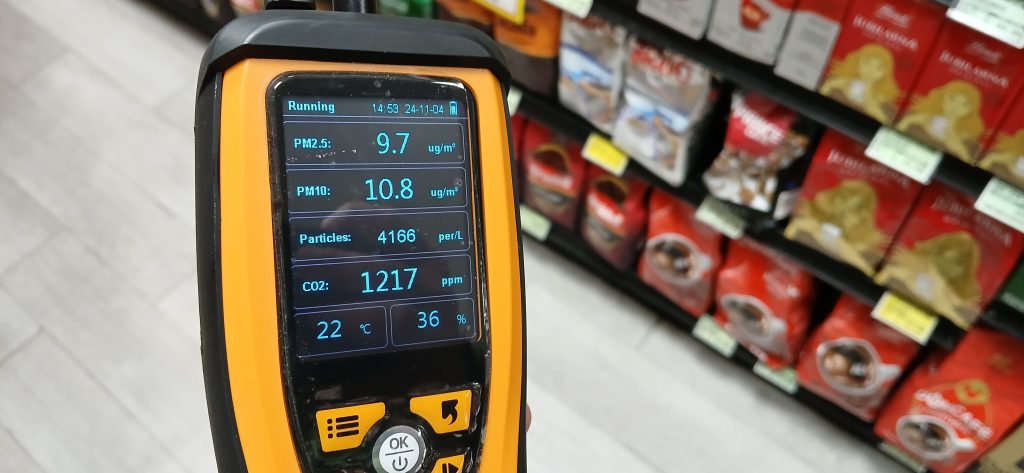
An orange Temtop air quality monitor shows 9.7 parts per million of PM2.5 particulate matter, 10.8ppm of PM10, 4166 particles per liter and 1217ppm CO2, at 22 degrees Celsius and 36% relative humidity, in a supermarket aisle.

All these factors were present in supermarkets I visited. When the supermarkets were relatively empty, I got low readings, but at peak times the carbon dioxide concentrations were very high. I got the highest readings by the checkout counters, even though they were near the doors. It could have been a quirk of my supermarket’s ventilation, but I think it was just so many people standing there and talking to each other.

Some of the worst readings I got were in doctors’ offices

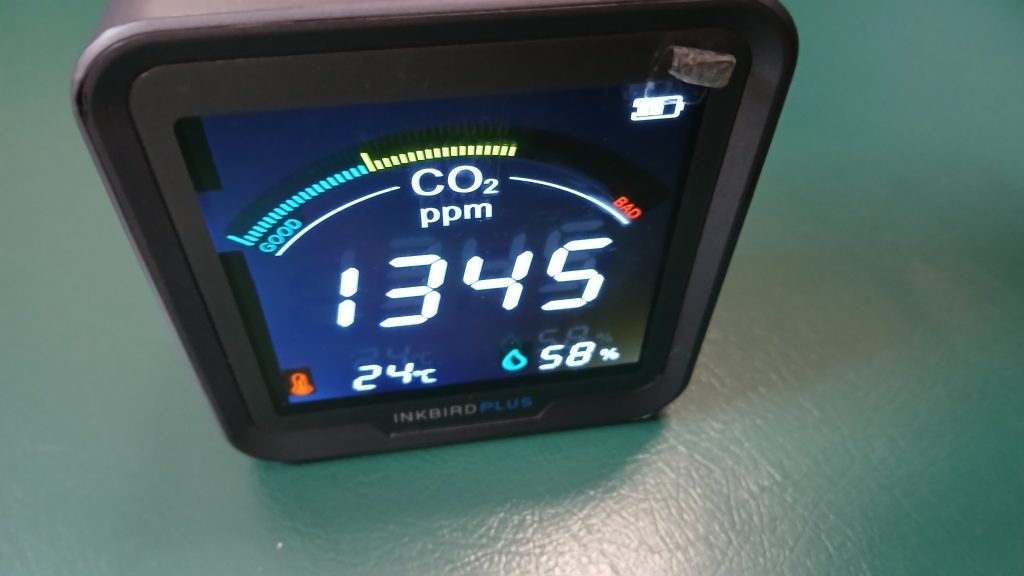
A carbon dioxide monitor sitting on a green pleather bench reads 1345 parts per million at 24 degrees Celsius and 58% relative humidity

I was very frustrated to find that some of my worst readings were in doctors’ offices, especially because I was bringing my elderly mother to doctors, and she wasn’t very careful about wearing her mask. I discussed this with my primary care doctor, who said she shared my concerns, and had tried to improve the ventilation, but her office was in a relatively old house without central air conditioning.

Even when transmission levels are low for respiratory diseases, I still try to wear a mask at all times in doctors’ offices, because many of the people in doctors’ offices are already sick, many of them are immunocompromised, and a lot of them have difficulty keeping their masks on. Discovering that the ventilation is not always good made it even more important.

Trains, buses and elevators are not always safe

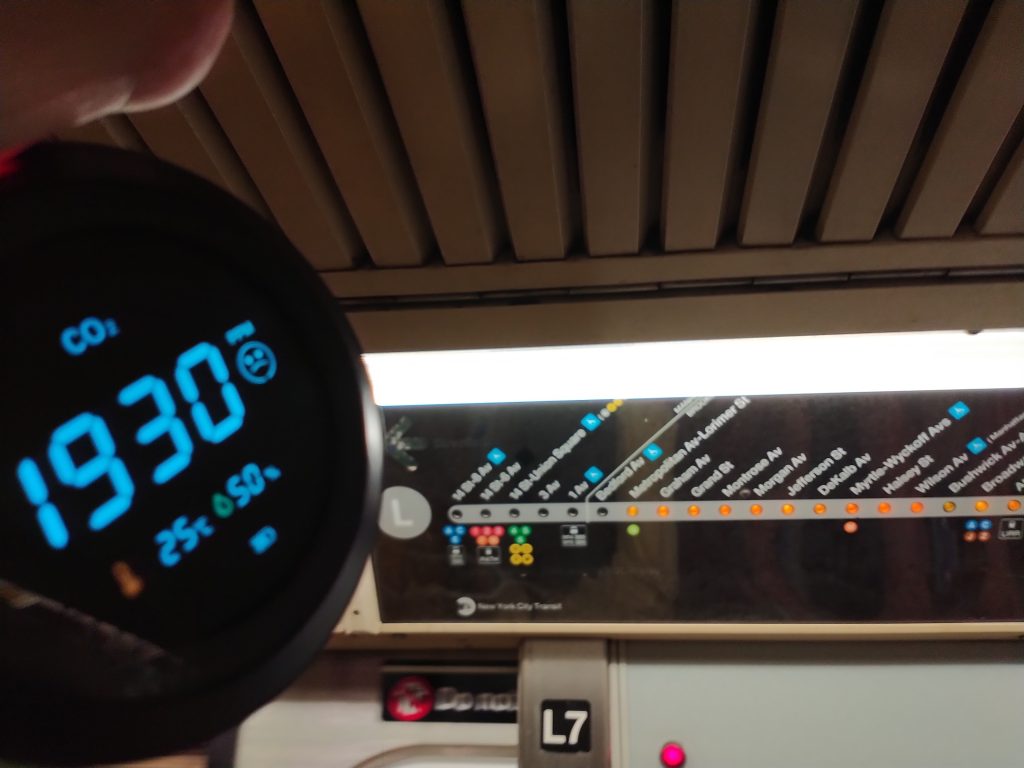
A carbon dioxide monitor reads 1930 parts per million, 25 degrees Celsius and 50% relative humidity.  In the background is a strip map for the L train of the New York City subway, showing that the train is eastbound between Bedford Avenue and Lorimer Street.

In 2020 there was a lot of speculation that subways and buses were a transmission vector for COVID in New York City.  Various studies showed mixed results, and it clearly wasn’t the only transmission vector, since hundreds of thousands of people got sick and killed without ever taking the subways or buses.  So are they safe?

What I’ve found is that when the subways are uncrowded, they’re safe.  If there’s room for everyone to sit, I see carbon dioxide concentrations close to outdoor levels.  But the ventilation can’t handle crowds.  If there are a lot of people standing, I get readings that are considered unsafe without a mask if transmission levels are high.  If a subway car is crush loaded – not enough room for people to move freely – I get readings that are considered unsafe even with a mask.

Airplane taxiing is the most dangerous time, mid-flight is the least dangerous, boarding is not necessarily safe

This is a pattern I heard about before I started monitoring carbon dioxide: when people are sitting quietly on an airplane and the jets are on, the ventilation system can generally handle things.  Similarly, when the plane is connected to airport power, it can keep the air pretty clean.

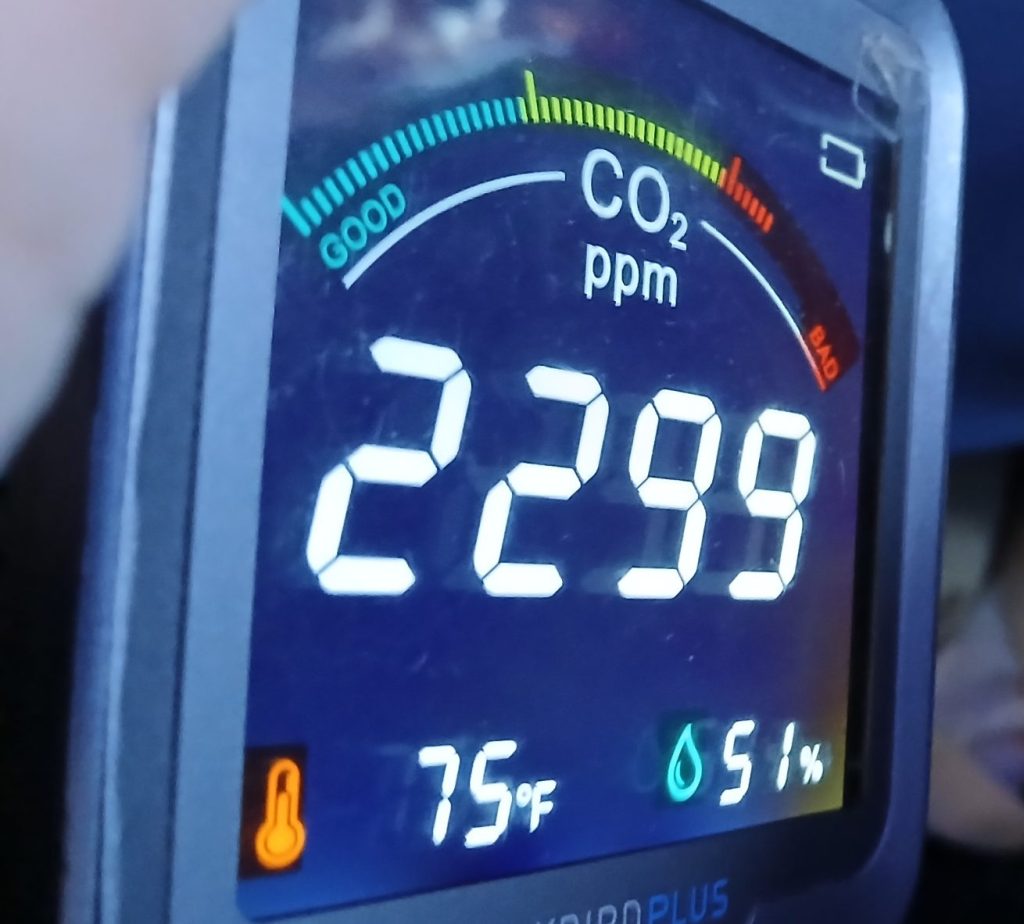
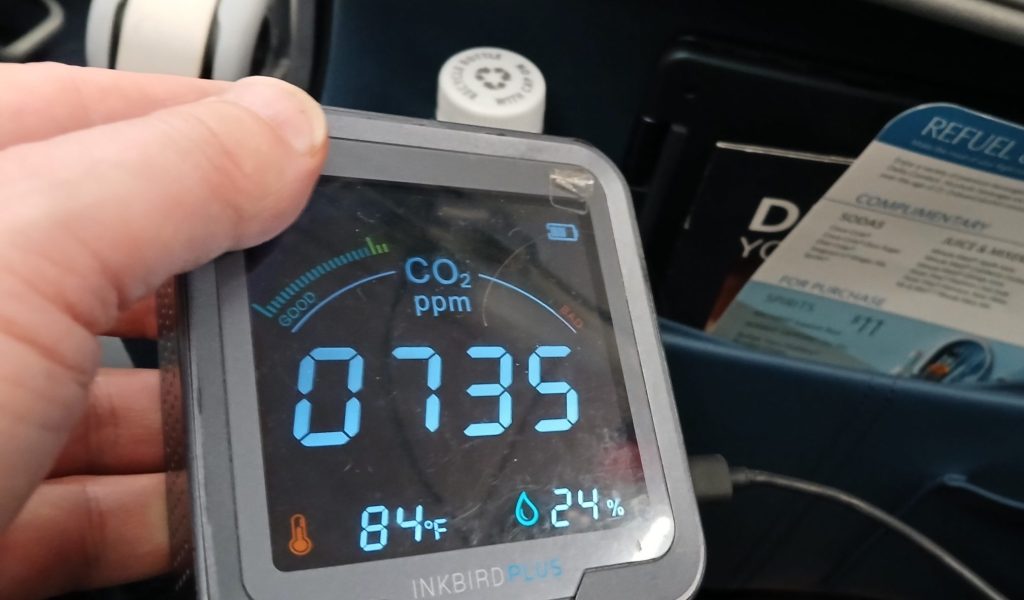
My readings generally confirm this: I’m writing this section on a fully booked Airbus 320 in mid-flight, and just got a reading of 750 parts per million, which is considered safe.  While taxiing I got a reading of 2299, which is not safe.  But with airport power, the system doesn’t seem to handle people moving around.   At the gate just before takeoff, I got a reading of 1826.

This also varies depending on how full the plane is, and how heavily the passengers are breathing.  But in general, if you don’t want to catch or transmit COVID or any other deadly respiratory infection, you probably want to keep your mask on from the gate until cruising altitude, and from descent until you get off.  Even if COVID transmission levels are low at both ends of the flight, because you don’t know who else is on the plane and where they’re coming from.

On long distance trains, dining cars are safer than coach cars

The ventilation on Amtrak is among the worst I’ve seen.  I’ve gotten some of my highest readings ever on a full Amfleet coach.  And that made me apprehensive, because I take trips that are five hours or longer, and I like to eat and drink.

Fortunately, people tend to get on and off Amtrak trains, so it often isn’t crowded the whole trip, and I found that the carbon dioxide concentrations went down as the car emptied out.  And I found that the levels were lower in the cafe car, even if all the seats were full and there were people standing in the aisle. My guess is that the seats are still much more spread out than in coach.

Look for spacious rooms with high ceilings

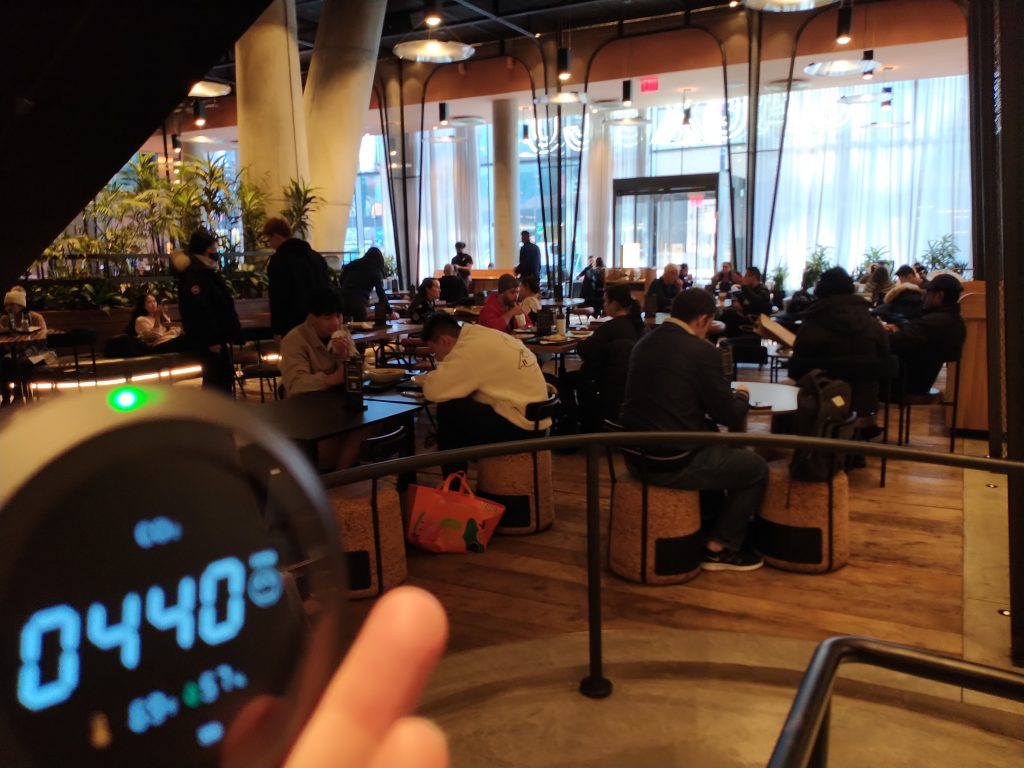
The JACX&Co food hall in Long Island City, where a carbon dioxide monitor shows 440 parts per million, at 69 degrees Fahrenheit and 57% relative humidity

In the winter of 2022, there were times when it really was so cold it wasn’t comfortable to eat outdoors. I had done enough testing that I suspected there would be places that would be safe to eat indoors. I took some carbon dioxide readings and substantiated that hunch: large spaces with high ceilings have low CO2 when they’re relatively uncrowded and people aren’t breathing heavily. The food hall trend was great for COVID-safe dining; I went to several food halls around the city at off-peak dining times and found safe CO2 levels.

I hope these observations help people to stay safe and keep others safe!

Commentary, COVID-19

So you want to monitor carbon dioxide levels

On an elevated train platform, a generic CO2 monitor reads 1230 parts per million, at 76 degrees Fahrenheit and 43% relative humidity.  An Aranet4 monitor reads 1335ppm CO2 at 79.6 degrees Fahrenheit and 47% relative humidity.  Both indicate that the levels represent moderate risk.  In the background is a New York City subway train with its doors closing, and a sign reading "Exit 52nd St & Roosevelt Av, 24 hour booth."

One amazing thing about the COVID-19 pandemic, compared with previous epidemics, has been the availability of high-quality open data, keeping medical professionals, epidemiologists and even the general public aware of trends and risks.  Ideally we wouldn’t have needed these, but too many politicians, doctors and public health professionals have chosen to play games with the data instead of making straightforward recommendations.

And yet, one area where there wasn’t enough information was indoor air quality.  We knew fairly early that COVID is transmitted in aerosol particles that can remain in the air for hours.  So we knew that enclosed indoor spaces were some of the most dangerous places to be, and uncrowded outdoor spaces were among the safest places.  We knew that masks helped prevent transmission, but we have to take our masks off to eat and drink.  But we didn’t have good guidance about which indoor spaces were the most risky, and which were the safest.

In 2022 I had friends who dismissed all the risks from COVID and tried to go back to their pre-COVID lives as quickly as they could.  I decided I wanted to continue taking precautions, partly because I don’t like getting sick, and partly because I realized it’s one of the easiest ways to save lives.  Our politicians were telling us just to go to concerts, eat indoors, fly on airplanes and work in offices, but I checked the statistics and saw that people were still dying – hundreds of people a day in some waves, just in New York City.  I wanted more clarity, so I bought a carbon dioxide monitor.

Why carbon dioxide?  Because everyone who exhales COVID (or flu, or RSV) aerosols also exhales carbon dioxide, and good ventilation removes both disease aerosols and CO2. Under many conditions, the concentration of CO2 particles in a space can give us an idea of how much risk there is of catching or passing on a respiratory disease.

Unfortunately, the relationship between the numbers on a carbon dioxide monitor and the disease risk is complicated, so there are some things to know if you want to do your own monitoring.  On the plus side, after over three years of checking the CO2 levels in a variety of places, I’ve learned a lot about how are moves around, to the point where I don’t feel the need to carry the monitor with me all the time.  In a future post I’m going to talk about some of the things I’ve learned through monitoring CO2, and in this post I’m going to discuss four things I learned about CO2 monitoring itself.

There are no absolutes

I would love it if we could just look at a readout and know how likely we are to catch a respiratory disease in any given room, but our bodies are complex and the air is complex.  The likelihood of transmitting COVID, the flu or RSV is affected by many factors including the temperature, humidity, wind, indoor ventilation, how many infected people are in the space, how infected they are, how heavily they are breathing, whether they are trying to project their voices, how robust the other person’s immune system is and whether they’ve been vaccinated against the strain that’s in the air.

The upper deck of a New York City Ferry boat, crowded with tourists on a sunny afternoon in December 2023.  In the background the towers of Four New York Plaza can be seen, and the Statue of Liberty is visible in the distance.

There have been studies suggesting that a person can catch COVID from another person who’s simply jogging past them in a park.  When I contracted COVID in the winter of 2023, one of the ways I might have gotten it was on the open, upper deck of a ferry crowded with tourists.

That said, during an outbreak, a general rule is that if the carbon dioxide levels are below 800 parts per million, it’s generally safe to not wear a mask, and if they’re over 1200 parts per million, an N95-type mask may not be enough to protect against these viruses.

Find a CO2 monitor that fits your budget

A monitoring device sits on a table next to an alcohol wipe and a tube marked "STERILE."  The device reports HCHO 0.308 mg/m2 and TVOC 2.000  mg/m2, but erroneously CO2 1965ppm at 73 degrees Fahrenheit and 35% relative humidity.

I started off with one of the cheapest carbon dioxide monitors available on Amazon, but I soon discovered that it didn’t directly measure CO2.  It measured the concentration of formaldehydes, and used a mathematical formula to estimate CO2, but that wasn’t always accurate.  In particular, it was affected by other sources of formaldehydes, like gas stoves, alcohol wipes and gasoline-powered cars.  These are not great for your health, but do not transmit these diseases.

I then bought another one on Amazon for around $80.  I was satisfied with it, so when the battery stopped charging, I bought a similar model.  They are listed under different brand names, but the one I have now is called INKBIRDPLUS.

The gold standard for CO2 monitoring is the Aranet4, which currently sells for a little under $200.  Another public health advocate lent me one for a couple of weeks, and I compared the output of the Aranet4 to the other two monitors, and found that the INKBIRDPLUS-type monitor tracked the Aranet4 fairly well.

Plants can affect CO2 levels without affecting respiratory disease levels

I know of two combination florist/cafes, one near my apartment and one near my office.  They’re both very pleasant, but I wouldn’t trust any carbon dioxide readings from there.  Plants consume carbon dioxide, and thus might cause the CO2 levels to be lower than those in a similar room without as many plants, but they don’t take virus aerosols out of the air.

Good air purifiers can reduce disease transmission, but won’t remove CO2

Air purifiers are the converse of plants: they can filter out disease aerosols, but carbon dioxide particles just pass right through them.  So we may get high CO2 readings, which can be bad in themselves, but they aren’t evidence that there’s a high risk of catching or passing on COVID, the flu or RSV.

Those are some things to keep in mind if you want to do your own carbon dioxide monitoring. In an upcoming post I’ll share some things I’ve observed from my CO2 monitoring.