The word “cisgender” is anti-trans

The word “cisgender” was coined to refer to people who aren’t transgender, as an alternative to problematic terms like “normal,” “regular” and “real.” Some have gone beyond this and asked their allies to “identify as cis,” and even treat trans people as the default realization of their genders.

As a trans person and a linguist, I disagree with these last two for a number of reasons. As I wrote last month, it’s bad etymology, and there is no evidence it will work. You might ask, well, what’s the harm in trying? The problem is that there is a cost to using “cisgender”: it divides the trans community. This may seem surprising at first, but it hinges on the fact that there are at least four different but overlapping meanings of the word “transgender.”
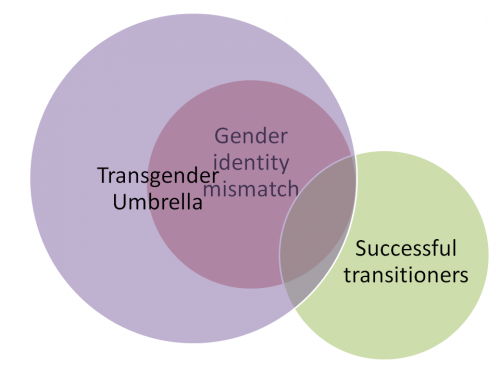
tg-definitions1The original use of “transgender” was as an “umbrella” term including transvestites, transsexuals, drag queens, butch lesbians, genderqueer people and more. Another popular definition is based on “gender identity,” including everyone who believes that their essential gender is different from the one assigned to them at birth. A third sense is based on feelings like gender dysphoria, and a fourth is restricted to those trans people who transition. Trans people regularly argue about these definitions, but in my observations it is common for a single person to use more than one of these senses in the same conversation, and even the same sentence.

These overlapping meanings produce what I call the Transgender Bait and Switch. Intentionally or not, many trans people use the broader “umbrella” or “dysphoria” definitions to show the largest numbers, neediest cases or historical antecedents when they are looking to get funding, legitimacy, or political or social support, but then switch to narrower “identity” or “transition” senses when they are deciding how to allocate funding or space resources, or who is entitled to speak for the group, or who is an acceptable representation of trans people in the media.

This is a problem because the meaning of “cis” depends on the meaning of “trans.” Who are the “cis” people? Are they the opposite of “umbrella” trans – those who don’t belong to any of the categories under the umbrella? Are they the opposite of “identity” trans – those who do not believe they have a gender different from the one assigned them at birth? The opposite of “feeling” trans – those who do not feel gender dysphoria on a regular basis? Or are they the opposite of “transition” trans – those who don’t transition? I’ve heard all four uses.

For all their lofty claims about the goals of “cis,” when trans people use it they do so to exclude, and typically they focus on excluding the marginal cases as part of the Transgender Bait-and-Switch: people who fit in one definition of “trans” but not another. It has become commonplace to refer to drag queens as “cis gay men,” and gynophilic transvestites as “cis straight men.” Drag queens, transvestites, non-binary people and others are regularly challenged when we try to speak from our experiences as trans people, and the refrain is always: “You are cis, you have not transitioned, you do not have the same experience.” Meanwhile, the same people seem to have no problem presenting themselves as the representatives of the transgender umbrella when they want to, even when they do not have experiences of drag performance, fetishism or non-binary presentation.

The best known challenges to “cisgender” have come from people who are not trans under any definition: didn’t transition, don’t have a gender identity mismatch, don’t feel chronic gender dysphoria, and don’t fit in any of the identities under the umbrella. They claim that the word is used as a weapon against them. They have a point: many trans people blame “cis people” for oppressing them, conveniently ignoring the fact that we’re just as capable of oppressing each other as they are of oppressing us. And it is counterproductive: since almost all estimates – using any of the definitions – put us at less than one percent of the population, we can’t live without non-trans people.

But the reason I hate “cisgender,” the reason I’m asking you not to use it, is because it’s used as a weapon to exclude other trans people. When they want money, we’re trans. When they want to claim our legacy, we’re trans. But when we want some of the money, we’re “cis.” When we want representation, we’re “cis.” When we want to speak for the trans community, or even for our segment of the trans community, we’re “cis.”

“Cisgender” divides the trans community and reinforces a hierarchy with transitioned trans people on top and nonbinary people, drag queens and transvestites at the bottom. So next time your transgender buddy Kyle tells you to “identify as cis” to prove you’re a real ally and stay on the invite list to his parties, I’m asking you to tell him no. Tell him that your transgender buddy Angus said not to. And if he tells you that I don’t count because I’m not transitioning, tell him he just proved my point. And his parties suck anyway.
Will “cisgender” work?

Some people have come up with the word “cisgender” to refer to people who aren’t transgender, as an alternative to problematic terms like “normal,” “regular” and “real.” Some have gone beyond this and asked their allies to “identify as cis,” and even treat trans people as the default realization of their genders. As a trans person and a linguist, I disagree with these last two for a number of reasons.

One quick objection that I have to get out of the way: “cisgender” is bad etymology. It’s true that “cis” is the opposite of “trans,” but only in the sense of location, existing on this side or the other side of a boundary. We are “trans” in the sense of direction, crossing from one gender expression to the other. In Latin as far as I know there is no prefix for something that never crosses a boundary. Of course, that’s a silly objection. We have plenty of words based on inaccurate analogies and they work just fine. I just had to get it off my chest.

Now, for real: the simplest objection is that there is no evidence “cis” will work as advertised. First of all, default status is not necessary for acceptance or admiration. Blond hair is marked in the United States, and that can make some people with blond hair unhappy. But there is no real discrimination or harassment against people with blond hair, not like that against trans people. People with English accents are marked, but they tend to be admired.

Transgender people (under almost any definition) make up less than one percent of the population. Do we even have the right to ask to be the default? Why should everyone have to think about us a hundred percent of the time when they only deal with us one percent of the time? Why should we be the default and not, say, intersex people?

Let’s say we manage to convince everyone to make us the default and themselves the marked ones. How is that going to make them more tolerant or accepting of us? There are plenty of groups who are or were the default, and even the majority, but were oppressed anyway: Catholics in British Ireland, Muslims in French Algeria, French Canadians in Quebec before the Quiet Revolution. The people who tell everyone to say “cis” don’t mention any of this.

The proponents of “cisgender” do not point to any time that this strategy has succeeded in the past, because there is no evidence of it succeeding. There are in fact intentional language changes that have some record of success, like avoiding names with implied insults. Switching the marked subcategory of a contested category is not one of them.

The main reason to not say “cisgender” is that it probably won’t work. If it were easy to get everyone to say “cis,” and it had no negative consequences, I would say that we should all just go ahead and say it, knowing full well that it probably won’t work, to humor its proponents. But the fact of the matter is that it does have negative consequences, consequences that affect me directly. I’ll talk about them in the next post in this series.

In the meantime, if you want to do something to help us, I’ve got some suggestions for you on my Trans blog. You can ask your friends and family to take a pledge not to kill us, or not to beat trans teenagers. You can even write the missing hip-hop song where a guy treats a trans woman with something other than violent contempt.

Trans, cis and the default

In a recent post, I talked about one reason that the word “cisgender” was coined. I agree that it is a good idea to have ways of talking about people who aren’t trans without evoking a context of “real” or “normal” to imply that we are not legitimate or to highlight our minority status. If this were the case, something like “non-transgender men” might be enough. But many of the arguments for “cis” go beyond this.

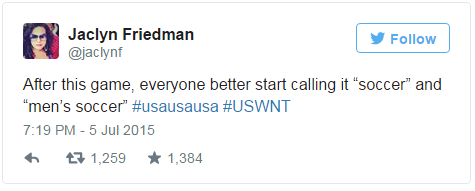
The first step beyond simply using “cis” is asking non-trans people to “identify as cis.” The idea is that trans women are marked as “not normal” just by virtue of having a word for ourselves, while non-trans women are the default “women.” There are similar situations for women in general, for example in soccer:

@jaclynf After this game, everyone better start calling it ?soccer? and ?men?s soccer? #usausausa #USWNT

Asking people to “identify as cis” – possibly as a condition of being accepted as an ally – means asking them to center trans people as the norm and mark themselves as deviating from that norm, at least in that context.

Some people have gone beyond simply asking people to “identify as cis,” and made a point of criticizing the use of unmodified “woman” in contexts that do not apply to all (or any) trans women. The idea is not just to make “trans” one acceptable default, but to exclude anything else from default status.

These three linguistic goals – replacing words like “normal,” admitting “trans” as a possible default status, and removing default status from non-trans people – are all aimed at removing the stigma associated with transgender actions. This stigma is real: I’ve received dirty looks and received petty harassment for wearing women’s clothes.

Of course, I’m relatively fortunate. I have never been attacked for being trans. I have received unconditional love and support from my family, and found a reasonable amount of success in my work life and acceptance from my neighbors. Others have been fired, kicked out of their homes, beaten and even killed for “being a man” in a dress or in the women’s bathroom – or for *not* “being a man” enough in the family or the workplace.

This stigma is not fair, and it needs to stop. The question is whether a word like “cisgender” can confer default status on us, whether default status will actually help to stop it, and if so how much.

Radical categorization and the difficulty of doing justice

In my last post I mentioned three caveats that I wanted to add to Miriam Posner’s keynote address to the Keystone Digital Humanities Conference, and I discussed the fact that the categories we use to organize our lived experience are slippery and problematic and just as reified as the ideological categories employed by researchers.

In this post I want to address some of the difficulties of doing justice, which are intertwined with those difficulties of categorization. Here?s a quote from Posner that gets to these difficulties:

Of course, we can?t capture these experiences without the contributions of the people whose lives we?re claiming to represent. So it?s incumbent upon all of us (but particularly those of us who have platforms) to push for the inclusion of underrepresented communities in digital humanities work, because it will make all of our work stronger and sounder. We can?t allow digital humanities to recapitulate the inequities and underrepresentations that plague Silicon Valley; or the systematic injustice, in our country and abroad, that silences voices and lives.

There is a perception that the world is divided into oppressed and oppressors, and that if we can just restore the balance of power, oppressors will no longer be able to oppress and justice will prevail. In language this finds its expression in “say this, not that” documents like the language guide produced by staff at University of New Hampshire that claims to offer “Bias-Free Language.” In the digital humanities setting that translates into the idea that if we can just include all the relevant underrepresented communities our work will be pure.

I don?t think that Posner had anything so simplistic in mind, but there?s a good chance that several people in the room, and some more people reading the written version, came away with just such a simplistic reading. To me this spells trouble, of a kind I?ve encountered before. Here are some further cautions based on my experiences when advocating for myself and people who are kind of like me in transgender communities.

One source of trouble is the idea that oppressed groups are monolithic entities. Categories are messy and slippery, and that especially goes for categories of people, like the ones we?re trying to include. What if we include an underrepresented community, but we use the wrong definition for that community and wind up excluding an even more underrepresented subgroup? I?m serious, it happens all the time.

And it gets worse, because the oppressed can oppress. Being a member of an underrepresented community does not make anyone a saint, and it does not give anyone an omniscient view of the community. People can, and do, exclude and silence segments of their community, out of greed, fear, hate and even simple ignorance. And they often do it by manipulating those slippery categories.

It?s important to remember that collective decision-making is problematic. In the trans community we don’t hold elections, whether to name our ?community leaders? or to decide which words are taboo today and which words every right-thinking ally is required to drop in their conversation before they can be invited to the cool parties.

Finally, nobody is completely honest, either with themselves or with you. Sometimes we repeat what others say without giving it much thought. Sometimes we have a nagging feeling there?s some big logical disconnect in what we?re saying but we don?t have the time to rethink it all. Sometimes we live in a fantasy world because the real world is just too painful. And sometimes we have a hidden agenda that we?re not going to share with you.

I say this as someone who?s had to sit and listen as my transgender ?community leaders? regurgitated dismissive characterizations of my subgroup in radio interviews. As someone who?s read blog posts claiming that we don?t belong in the community, even though the same bloggers are happy to claim us at fundraising time. As someone who has read dozens of tweets and Facebook posts on transgender topics by outsider ?allies? ? friends, neighbors, colleagues, students ? that center the noisiest subgroup in our community and erase the group that I belong to.

You can?t include me by hiring that genderqueer kid who gave the cool speech at campus Pride last year. You can?t include me by co-authoring a paper with the late transitioner who bent your ear about access to hormones at the Decolonizing Culture Conference. You can?t include me by interviewing the director of the local Gender Authenticity Center, or by reading the book by that woman who was on Oprah.

In fact, if you hadn?t read my blog or my Twitter feed, you might not even know that I exist to be included. And even if you find me and manage to include me, that?s no guarantee that you haven?t missed some equally important, unrepresented segment of the transgender community that I?m also completely unaware of.

You can?t include everyone. It?s just not going to happen. We need to be mindful of this and set our expectations accordingly about what we know, and how far we can generalize that knowledge.

This is why in the question and answer period, I asked Posner if she would accept my interpreting her speech as a call for humility. She responded by saying that it was actually a call for hubris on the part of the excluded and silenced groups. Later at the reception I proposed a synthesis where hubris was called for on the part of those less powerful, and humility on the part of those with more power.

Posner accepted my synthesis at the time, but thinking about it now in the light of what I just wrote about how the oppressed can oppress, I?m not sure I?m comfortable with it any more. Calling for hubris from those less powerful sounds like an invitation to self-appointed ?community leaders? to promote their vision of the community, without stopping to reflect on the possibility that they might be excluding or silencing others in turn.

Humility is most important for those of us with the most power. We need to keep that perspective on what we do. But it is still important for those of us with the least power. It is never not important. If Posner will not call for humility, then I will. Justice is hard. Please, be humble. Let every feeling of power be an invitation to humility. And thanks.

Challenges for radical categorization

I enjoyed Miriam Posner’s keynote address at the Keystone Digital Humanities Conference. It was far from the only talk last week that was animated by a desire for justice and compassion, and it was good to see that desire given such prominence by the organizers and applauded by the attendees.

As a linguist I also welcomed Posner’s focus on categorization and language diversity. I was trained as a syntactician, but over the past several years I have paid more and more attention to semantics, and categorization in particular. Building on the work of Ludwig Wittgenstein, Eleanor Rosch, George Lakoff and Deborah Cameron, I have come to see categorization as a touchpoint for social justice.

I should note that for me, categorization is not just where I can advocate for others with less power. As a transgender person, the power to categorize myself, my feelings, my beliefs and my actions is denied to me on a daily basis. The main reason that I study categorization is to regain that power for myself and others.

Much as I share Posner’s passion for justice, her talk raised some concerns in my mind. First, digital humanities cannot bear the entire burden of social justice, and even language as a whole cannot. Second, categories are slippery and flexible, which is a great strength of humanity but also a great weakness. Third, there are limits to how much we can trust anyone, no matter how high or low they are in the hierarchies of power. These concerns are not insurmountable barriers to a radical approach to categorization, but keeping them in mind will help us to be more effective fighters for social justice.

I plan to address the issues of the burden and trust in future posts, and in this post focus on the slipperiness of categories. As I understood it, Posner drew a distinction between the data models used by digital humanists (among many others) to categorize the world, and the lived experience of the people who created and consume the data.

There is often conflict between the categories used in the model and in the experience, and there is often a power imbalance between the digital humanist and the humans whose data is being modeled. Digital humanists may be perpetuating injustice by imposing their data models on the lived experiences of others. Posner gave examples of binary gender forms, database fields for racial classification, and maps of places. She contrasted these models imposed from above with examples where humanists had contested those models, aiming to replace them with models closer to the lived experience of people with less power who had a stake in the categorization.

The problem is that our lived experience is also a data model. As George Lakoff and other cognitive scientists have shown, the categories that humans use to describe and interpret our experience are themselves conventions that are collectively negotiated and then imposed on all members of the language community, with penalties for non-compliance. They are just as distinct from reality as the fields in a SQL table, and they shape our perceptions of reality in the same ways.

Whether or not they are encoded in HTML forms, categories are always contested, and the degree to which they are contested is a function of what is at stake to be gained or lost from them. In my experience, categorizing people, whether by race, gender, nationality, religion or other criteria, is the most fraught, because these categories are often used as proxies for other factors, to grant or deny us access to valuable resources. The second most fraught is the categorization of place, because places contain resources and are often proxies for categorizing people. After that, food seems to be the most fraught; if you doubt me, ask your Facebook friends for the most (or least) authentic Mexican or Italian restaurant.

And yet, as Wittgenstein and Rosch have observed, it is normal for categories to have multiple, slightly different, meanings and memberships, not just in the same language community but in the same individual. In my observations it is possible for the same person to use two different senses of a word – a category with two different but overlapping memberships – on the same page, in the same paragraph, in the same sentence.

Responding to Posner’s talk, Matt Lincoln posted a recipe for using the Resource Description Framework (RDF) to describe overlapping, contrasting systems of categorization. I think that is an excellent start, particularly because he places the data models of lived experience on the same level as those imagined by the researchers. My word of caution would be to keep in mind that there is not one singular data model for the lived experience of a community, or even for an individual. As Whitman said, we contain multitudes. Each member of those contradicting multitudes has its own data model, and we should thus be prepared to give it its own entry in the RDF.

I and others brought up similar issues in the question and answer period, and in the reception after Posner’s keynote, and I very much appreciate her taking the time to discuss them. As I remember it, she acknowledged the challenges that I raised, and I look forward to us all working together to build a humane, compassionate humanities, whether digital or not. I will discuss the challenges of bearing the burden and of trusting the community in later posts.

Both of them?

When I wrote about my son’s use of “they” pronouns to refer to a single, specific person, I mentioned how there are people who want to be referred to with “they” or another set of gender-neutral pronouns because they don’t want to be identified by a gender. This change is also happening, but it’s not as straightforward as it sounds.

A few months ago I got into a small argument on Facebook. A former student of mine had posted something about transgender issues, and two of his Facebook friends disagreed with a comment of mine.

A few days later I ran into my student on campus, and he mentioned that one of the friends was his partner. “They just came out, so they get a little excited about these issues,” he said. This often happens to people when they come out, so I was not surprised.

At the time I assumed my student was saying that both of his Facebook friends had just come out. Two people coming out at about the same time? Well, it’s college, and my student is one of the officers of the campus LGBT group.

It was only later that it occurred to me that my student might have been talking about a single person (his partner) who had come out as genderqueer, and thus used “they” pronouns.

A few weeks ago I organized a karaoke event for members of my transgender support group, which is open to all genders. I was presenting as a woman, so everyone called me Andrea and referred to me with “she” pronouns. Another member of the group was presenting as a man but had asked us to use a feminine name and “she” pronouns, so we did.

At the event there were a few people who hadn’t shown up yet. I asked about one person, and the answer was, “They said they weren’t feeling well, so I don’t know if they’re going to make it.” Now, I knew that this person identified as genderqueer, and had complained that their boyfriend was reluctant to use “they” pronouns, and still my first thought was, “Oh, was the boyfriend planning to come too?”

I tell these stories to show that, at least for me, if I hear “they” in a specific context, I expect it to be plural. But hold on! This is not going to be some reactionary rant.

I don’t think it’s impossible for me to understand “they” as referring to single, specific people. I don’t think it’s impossible for entire communities of English speakers, or even the whole population, to make that shift. I don’t think it’s unreasonable to ask me or anyone else to try.

I do want to point out that these are pronouns, part of our entrenched, high-frequency core grammar, so it’s not going to be as easy as shifting from “stewardess” to “flight attendant.” On the other hand, using “they” pronouns would be easier than adopting any of the pronoun sets that have been specifically invented for gender-neutral use.

It would actually be easier if we used “they” pronouns for everyone, like my son may be doing part of the time. We’d have to come up with some way to specify plurality then, like “those people.” Let me know if you hear anything like that?

Why some people like “cisgender”

The news these days is that “cisgender” has been added to the Oxford English Dictionary. The OED is a descriptive tool, so if people are using the word, the editors should put it in. But as a transgender person, I don’t like the word and I’m not happy people are using it.

Ben Zimmer had a nice writeup about the word in March. When I commented on twitter that I hated the word and intended to write up everything wrong with it, he responded that he “would be very interested in your take.”

Since then, I’ve been trying to articulate what bothers me about the word. It doesn’t help that among trans people there’s a very real habit of policing not only language but ideology: I just got called out on Twitter for a related issue. So I’ve gone through several false starts on this.

I’ve decided to break it up into a series of blog posts, and in the first one I’ll talk about why the word “cisgender” is so appealing to some people. Consider the following sentences, found on various web pages:

  1. Man Chose A Transgender Woman Instead Of A Real Woman
  2. your bone structure will grow much like a normal woman’s would.
  3. She has no more muscle mass than a regular woman.

You can see why people have problems with these. If you’re not “normal” or “regular,” you’re stigmatized. I don’t think that’s right, but it would be a lot of work to change it. To many people it seems easier to simply change the words so that you’re no longer not “normal.”

Not being “real” is even more objectionable, especially to transgender people who transition. It plays into the narrative of the trans person as deceiver, a fake person constructed to defraud innocent men and women of their love and their drink money.

The idea of “real” also plays into binary constructions of gender, where everyone is “really” either a man or a woman, and many activities, spaces and forms of expression are restricted to one gender or another. Intermediate and mixed presentations are discouraged, and switching back and forth is prohibited. In the gender binary, it is impossible for a single person to be really both a man and a woman, or to be a real man one day and a real woman the next.

Before we were trans women we were transvestites, cross-dressers and transsexuals, and we had a word for women who weren’t trans: “GG.” It’s been claimed to stand for “genetic girl,” which didn’t make any literal sense because gene tests weren’t readily available then, and for “genuine girl,” which was at least as problematic as “real woman.” The second part, “girl,” was further condemned as infantilizing by feminists, which may have contributed to the word’s decline.

So yes, it is a good idea to have ways of talking about people who aren’t trans without evoking a context of “real” or “normal” to imply that we are not legitimate or to highlight our minority status. Do we need “cisgender” to do it? I’ll write about that in future posts.

America’s Loveliest Accents: Baltimore

I’ve never been to Baltimore, but I would like to visit one day. I’ve never watched “The Wire,” but I’ve seen a couple of John Waters movies.

I also went on a date once with a woman from Baltimore. She herself mentioned her accent, in particular that she pronounced her hometown’s name as [bɒɫdəmɚ], like “Bald o’ mer” (this is different from the stereotype I later heard with “Bowlmer”). It didn’t work out, but I’ll just say that I found her very attractive, including her accent and not despite it.

And yes, this is kind of a lame post. That’s the point: that I can say something nice about this accent and a lot of others without doing any research whatsoever. You can too.

I’ve avoided following the original Gawker series “America’s Ugliest Accent,” that inspired Josef Fruehwald’s blog post that inspired this series, but Ben Trawick-Smith (no relation that I know of) has a summary of other people’s reactions to the Gawker series, and adds his own.

There are other accents that weren’t part of the Gawker sixteen, and that I may discuss at some point. I’ve lived in New Mexico and North Carolina, which both have very interesting accents (North Carolina actually has several; just ask Walt Wolfram and his colleagues). And my native Hudson Valley accent doesn’t get much attention at all, living as we do in the shadow of the New York accent.

In conclusion, you’re entitled to your own feelings about any accent. But to reinforce what Fruehwald and Trawick-Smith said, usually the opinions that people hold about an accent are just the opinions they have about the speakers of that accent, thinly disguised. Accent prejudice is ethnic and class prejudice.

If you wouldn’t put up with someone saying that black people look ugly, then don’t put up with someone saying that black people sound ugly. If you wouldn’t put up with someone saying that New Yorkers are uneducated, then don’t put up with them saying that New Yorkers sound uneducated.

Question your own prejudices. If you find yourself judging people for the way they pronounce certain words, or correcting them, ask yourself what it is that really bothers you.

Set an example. If you hear someone speaking with an accent that could invite rejection or ridicule, do your best to treat them with the same respect that you would anyone else. And if you notice that you’re criticizing your own speech, take a minute and give yourself the space to love yourself for who you are.

This is part sixteen of a series where I say nice things about all sixteen of the accents that Gawker?s Dayna Evans nominated for ?America?s Ugliest Accent.? Previously: New Orleans.

America’s Loveliest Accents: New Orleans

There’s a stereotypical “Southern” accent you’ll hear in mid-twentieth century movies and television, that owes more to Clark Gable and Vivien Leigh’s artificial accents than to anything that ever came out of the mouth of any real-life Southerner. It may bear a passing resemblance to the accents of real Coastal Southern gentry like Fritz Hollings, but it’s been used to portray people from all regions and social classes of the South. In the last fifty or so years we’ve heard a new stereotype that’s at least based on real Southerners like Dolly Parton and Elvis Presley, but it’s been applied to rich and poor white characters from Dallas to Knoxville to New Orleans.

YouTube user Mehrvigne, from Chalmette, Louisiana, wants us to know that some people from the New Orleans area don’t talk anything like that. Katie Carmichael, who just finished her dissertation on Chalmette accents after Hurricane Katrina, pointed me to Mehvigne’s “accent tag” video on Twitter.

Mehrvigne has a “Yat” accent, which bears an uncanny resemblance to working-class New York and Boston accents, and is said to have evolved from similar patterns of European immigrants acquiring an /r/-dropping dialect.

The “Yat” dialect is just one of several New Orleans accents, and it’s one that I actually didn’t hear when I visited the city back in 2010. It exists alongside other accents spoken by white, black and Asian (NSFW) people in New Orleans. To get an idea of the diversity of the area, listen to these two teenage girls doing an accent tag together:

This is part fifteen of a series where I say nice things about all sixteen of the accents that Gawker?s Dayna Evans nominated for ?America?s Ugliest Accent.? Previously: Charleston. Next, and last but not least: Baltimore.

America’s Loveliest Accents: Charleston

In my post about the Memphis accent, I discussed how the Mountain and Coastal (white) Southern dialects have very distinct origins. So why do they sound “the same” to many people? In part it’s because they’ve become more similar over the years.

At first it was the Mountain South imitating the Coast. Virginia, the Carolinas and Georgia all controlled large mountain areas from their coastal port capitols in Williamsburg, New Bern, Charleston and Savannah, and later from their Piedmont capitals in Richmond, Raleigh, Columbia and Atlanta. It was fashionable among certain people to imitate the elites, and those elites spoke mostly with Coastal accents.

In the late twentieth century with the rise of the “New South” centered around Appalachian and Piedmont centers of cheaper labor, cultural and political power shifted to cities like Nashville, Charlotte and Louisville. With wider access to radio and television, and better roads connecting them to regional capitals, Southerners have had more exposure to regional accent role models.

African Americans in the South have also tended to shift from local accents to a regional or national model of “sounding Black.” Walt Wolfram and his colleagues have documented this divergence between black and white accents in Hyde County, in coastal North Carolina, in a fascinating series of studies.

Charleston

Charleston used to be known for its conservative, genteel coastal Southern accent, which you can hear in the speech of former Senator Fritz Hollings.

I’ll admit I had to look this one up. Darius Rucker, lead singer of Hootie and the Blowfish, is from Charleston. I’ve heard Hootie dismissed by some music snobs, but is there anyone who thinks Rucker doesn’t have a lovely voice?

What I find most interesting is that to my ear he sounds almost nothing like Hollings. Is that because he’s black, or because he’s younger, or both?

This is part fourteen of a series where I say nice things about all sixteen of the accents that Gawker?s Dayna Evans nominated for ?America?s Ugliest Accent.? Previously: Atlanta. Nextly: New Orleans, and finally Baltimore.