Commentary, Greenwich Village

Wittgensteinian villages

Last month I guessed that when Ari Wallach said that Hastings-on-Hudson is a village “in a Wittgensteinian sense,” he meant that it was part of a family of things that are called “villages,” but don’t all share the same set of criteria. Wallach confirmed on Twitter that this was what he meant.

Wittgenstein’s example came from the area of games, where poker is competitive and contains elements of chance, tic-tac-toe is competitive but involves no element of chance, and solitaire contains elements of chance but is not competitive. Meanwhile, there are things that are not games but are competitive, like war, and things that are not games but involve chance, like weather forecasting.

games2a

In my previous post I had four criteria for “games,” but I chose to focus on two of them to make the diagrams easier to read.

Similarly, George Lakoff argued, a typical mother provides genetic material to her child and nurtures the child once it is born. A genetic mother does not necessarily nurture the child and an adoptive mother does not provide genetic material, but they are both considered to be mothers. A father can provide genetic material, and an teacher can nurture, but they are not mothers. Lakoff calls these radial categories.

mother1b

(Strictly speaking, war contains elements of chance, and fathers can nurture, so the diagrams don’t quite fit the way people think about these categories, but it’s hard to capture everything.)

Back to Hastings-on-Hudson: it is legally incorporated as a village, but it is more suburban than rural, bordering on the city of Yonkers. Greenwich Village and Queens Village were once villages, but are now neighborhoods in New York City, and may not be considered villages by anyone anymore. Meanwhile, Huntington Village on Long Island is more rural, but is not legally a village. A typical village, like New Paltz, is incorporated and rural. Then there are rural areas like Wittenberg (where I spent a good part of my childhood, essentially a crossroads with a general store), and incorporated areas like Buffalo, that are not villages.

villages1

These “family resemblances” are everywhere in human categorization, and they are the basis for many of what I call “category fights.” The existence of this kind of polysemy is rarely acknowledged, unfortunately, and many people argue over these categories as though they were Platonic categories with necessary and sufficient conditions, when the actual facts are more complicated.
Commentary, News

In a Wittgensteinian sort of way

This weekend the New York Times Styles section ran one of their periodic stories about kids growing up and moving to the suburbs, and changing both themselves and the suburbs in the process.  A while back the suburb in question (more of an exurb) was Rosendale, and this time it was Hastings-on-Hudson.  This particular article was notable for its sheer number of evocations of the wacky hipster frame, and specifically the description by “futurism consultant” (sorry, I have to put that in quotes) Ari Wallach that Hastings is a village “in a Wittgensteinian sort of way.”

Blogger Kieran Healy responded by posting the “Top Ten Ways that Hastings-on-Hudson might be a Village in a Wittgensteinian Sense.”  And of course he’s right that it is a very funny quote, name-dropping a philosopher that hardly anybody has read in the original, in a “Styles” article about real estate trends.  I would crack up if I ever found myself saying something like that, and I hope Wallach has enough of a sense of humor to do the same.

What’s funnier to me, as I just realized yesterday morning, is that I have an idea what Wallach was saying, and I agree with him.  In fact, on Sunday I was at the Lavender Languages Conference arguing that I am transgender in a Wittgensteinian sort of way.  I didn’t use those words; instead I referenced George Lakoff, who got the idea from Wittgenstein via Eleanor Rosch.

I learned about Ludwig Wittgenstein in Philosophy of Language class 22 years ago, but that class was so rich with theories that I couldn’t keep track of them all.  So now I’m catching up with the help of Wikipedia, which gives us this quote (Philosophical Investigations 66, 1953) about the idea of “family relationships”:

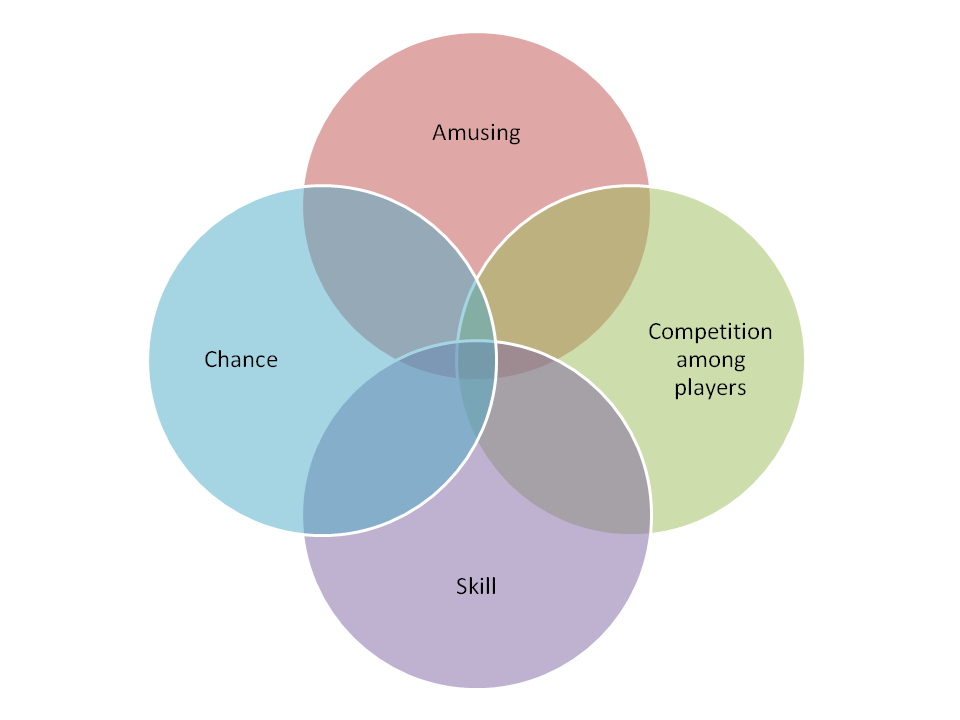
Consider for example the proceedings that we call ‘games’. I mean board games, card games, ball games, Olympic games, and so on. What is common to them all? Don’t say, “There must be something common, or they would not be called ‘games'”–but look and see whether there is anything common to all. For if you look at them you will not see something common to all, but similarities, relationships, and a whole series of them at that. To repeat: don’t think, but look! Look for example at board games, with their multifarious relationships. Now pass to card games; here you find many correspondences with the first group, but many common features drop out, and others appear. When we pass next to ball games, much that is common is retained, but much is lost. Are they all ‘amusing’? Compare chess with noughts and crosses. Or is there always winning and losing, or competition between players? Think of patience. In ball games there is winning and losing; but when a child throws his ball at the wall and catches it again, this feature has disappeared. Look at the parts played by skill and luck; and at the difference between skill in chess and skill in tennis. Think now of games like ring-a-ring-a-roses; here is the element of amusement, but how many other characteristic features have disappeared! And we can go through the many, many other groups of games in the same way; can see how similarities crop up and disappear. And the result of this examination is: we see a complicated network of similarities overlapping and criss-crossing: sometimes overall similarities, sometimes similarities of detail.

games2

I made this Euler diagram (which is not a true Venn diagram, according to the Wikipedian who made this page). Some of the games that Wittgenstein mentions, like Olympic track and field games, are amusing (in the sense of not being boring) and involve competition among players, skill and chance.

Other games fit only some of these criteria. There is no element of luck in chess or tic-tac-toe.  There is no competition among players in solitaire or throwing a ball at the wall.  There is no skill involved in ring-around-the-rosie.  Tic-tac-toe is not “amusing.”  Nevertheless, we call these all “games,” and if we tried to say that any of the four were necessary criteria we would exclude some of the games.

Similarly, these cannot be sufficient criteria either.  Surgery involves skill, but it is not a game.  Weather forecasting involves chance.  War involves competition.  Theater is amusing.  That said, they are often compared to games, and described with game metaphors.

This is a good place to stop.  I’ll talk in another blog post about how Hastings might be a village in this way.

Commentary, England

Cable cars across the ocean

I’m going on vacation to England soon, so I was intrigued to hear that Mayor Johnson had inaugurated a cable car across the Thames. “Funny,” I thought, “It’s not that hilly there.” Then I realized that “cable car” meant an aerial car, like what we call a tram.

CABLE CAR CABLE CAR

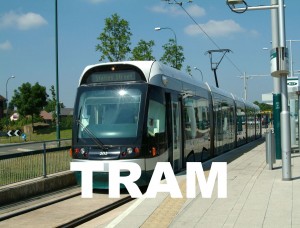
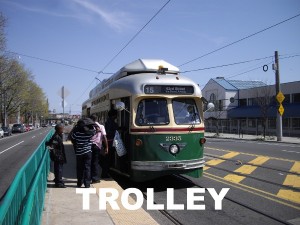
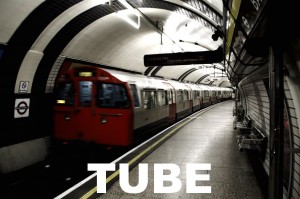
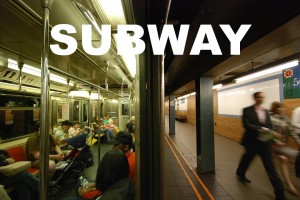
So I decided to put together this little guide to transatlantic transportation vocabulary differences. It was only after I was halfway done that I realized how much I had cribbed from the “Point of View” ad campaign created for the Hongkong Bank by Craig Davis of J. Walter Thompson (where my dad worked back in the “Mad Men” days). Good ads! Please click through to see the sources for the photos.

Tram:
TRAM TRAM
Trolley:
TROLLEY TROLLEY

Trucks:
TRUCKS TRUCKS

Tube:
TUBE TUBE

Subway:
SUBWAY SUBWAY
Commentary, Greenwich Village

Modern towers can respect the street

If you’re walking up Broadway in Greenwich Village, you’ll get to the block between Waverly Place and Eighth Street:

Notice how there’s a continuous row of shops (except for the garage) that respects the “build to” line, as do the shops on the following block. Above the shops is a setback, and then the 31-story Georgetown Plaza tower, built in 1965.

On the same block, right next to where I took the picture above, the shops continue with the venerable “Cozy Soup ‘n’ Burger” diner, a liquor store and the Delion Deli. Above them is the 35-story Hilary Gardens tower, built in 1972.

It’s not classic Greenwich Village urbanism or a quiet residential street, but it’s easy to walk and provides a stimulating visual environment. It fits in so well with the surrounding ground-floor retail that I only recently noticed that the buildings were postwar towers.

Contrast this with the boring vegetation along Washington Square Village, or the pointless lawn of Silver Towers.

If the Greenwich Village Society for Historical Preservation really wanted to “protect the character of our neighborhood,” they would ask NYU to build retail out to meet the sidewalks of Third, Bleecker and especially Houston Street. That’s what the area needs, not more pointless, inaccessible “open space,” and not to be frozen in amber in 1967.

Commentary, Greenwich Village

A beautiful residential block

Here is West Tenth Street between Sixth and Seventh Avenues:

Whenever I walk here I feel calmer and happier, much more so than on Mercer or LaGuardia, even though those streets have “green space.” Something about the buildings coming up to the lot lines and the subtle diversity of styles.

congestion pricing, Greenwich Village

The character of Silver Towers

The form letters that the Greenwich Village Society for Historical Preservation asks you to send to various officials all contain the same bullshit phrase: “Please protect the character of our neighborhood…”

Yes, that’s right. Some people believe that the character of Greenwich Village is intimately bound up with a curb cut leading to a filthy concrete garage entrance, an unadorned cast iron fence keeping the public off of a pointless lawn, and a car-free street that manages to be devoid of pedestrian activity. Oh, Scott Stringer, save this vulnerable piece of neighborhood character!

Commentary, Greenwich Village

Another pedestrian-unfriendly NYU backside

Here’s the back of the NYU Stern School of Business, facing West Third Street:

It has a decent sidewalk, but if you’re walking east, on your right you have parked cars and on your left you have this fence. Wrought-iron is better than chain link, but it’s still not very pleasant, and if you look through the fence all you see are ventilation ducts and other building support equipment. It’s not even like the back of Bobst Library, where you can at least look at people and books.

Commentary, Greenwich Village

Greenwich Village’s narrow streets

Last month, Cap’n Transit had a post about the Really Narrow Streets of Manhattan. Here is a narrow street in Greenwich Village, not too far from NYU.

I think we can safely say that Minetta Lane, about thirty feet wide, is not living up to its potential as a Really Narrow Street. In this case, there are three possible reasons that come to mind. First, the city is imposing a division of street and sidewalk that keeps the sidewalk too narrow for any real commerce to take place (see also parts of Paris), and bolstering this division by allowing the same 30mph speeds as anywhere else in the city, but allowing the division to be erased by the well-connected drivers of these vans. Second, the lots are large and have at most one retail establishment each.

There may be a noise issue here: I know that noise complaints are relatively common in the Village, but I don’t know how much residents may have complained specifically about the Minetta Lane Theater, Bellavitae or the back door of Cafe Wha?.

It turns out that there is quite a backstory, discussed by Stephen Crane and a number of posts on the Media History of New York blog. Will Minetta Lane ever transcend this history to become more than a quiet backwater where people just pass through and become a place once again?

Commentary, Greenwich Village

What’s wrong with this picture?

I feel kind of guilty complaining about this. Look, you’ve got a decent width sidewalk, the street isn’t oppressively wide, and you’ve got greenery! Shrubs! Plane trees! And two supermarkets within a few blocks!

I would have loved something like it in Albuquerque, or in Greenville. I would even prefer it to the development around Saint John’s. But this is not New Mexico, or North Carolina, or even Queens. It’s Manhattan.

Commentary, Greenwich Village

NYU’s back door problem

New York University has bought a lot of old buildings in the Washington Square area, and built a bunch of new ones.  This is a great example of adaptive reuse and infill development, better than building satellite campuses.  It’s not like they haven’t tried the suburban campus thing before: Bronx Community College occupies their old main campus, and Hofstra University was originally a branch of NYU.

Unfortunately, NYU hasn’t figured out how to integrate itself well at the street level.  The old stores, factories and apartments it replaced had multiple street entrances, but entrances are expensive to guard, so NYU only has one or two per building.  In some buildings there is street-level retail, often aimed at students and faculty, but many more have no entrances or windows.  You can see this in the above photo, looking west on Third Street, away from Washington Square Village.

View More