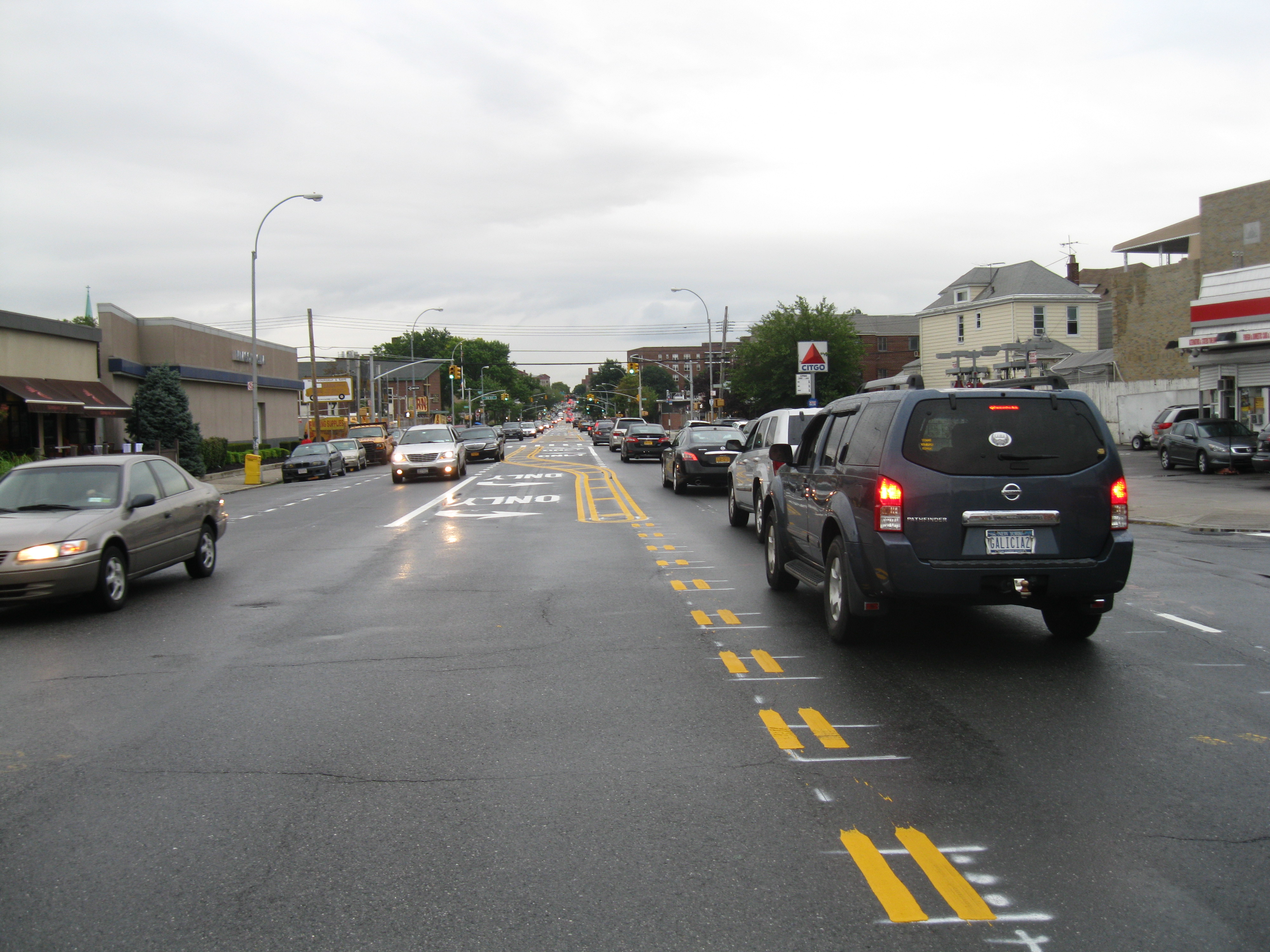
I am writing to tell you how excited I am for the new Bicycle Boulevard configuration on 39th Avenue, and how much I appreciate it.
When my wife and I were looking for an apartment in the neighborhood, we visited one in Sunnyside Towers at 46th Street and 39th Avenue, and we decided to rule out the entire building because it had no marked crosswalk in front of it. My wife was pregnant at the time, and we did not want to worry about our child crossing an avenue rife with speeding.
When my mother, who was 75 years old at the time and will be 83 this year, moved to an apartment on 50th Street and walked her dog across 39th Avenue, where there was also no marked crosswalk, to take advantage of the trash cans generously provided by the Phipps Corporation, I feared for both their lives.
When I found out that 39th Avenue was chosen as one of the city’s Open Streets, I was excited to incorporate it into my daily exercise routine. That excitement was short lived, as speeding drivers ignored the barricades. After I was menaced and harassed on 39th Avenue by a city employee in a Parks Department pickup truck, I found it difficult to work up the courage to walk outside in my own neighborhood.
Now I am excited once again to see the new Bicycle Boulevard improvements being installed. There are marked crosswalks and pedestrian refuges in front of Sunnyside Towers and the Phipps Gardens, as well as in front of Sunnyside Gardens Park. I feel safe once again walking 39th Avenue every day, and I have already lost a few pounds.
Have I been inconvenienced by the Bicycle Boulevard? A little: when I call a Lyft to bring my mom to the doctor, the driver may have to take a slightly longer route. Is it worth it to know that my family and my neighbors and I are better protected from speeding cars? You bet.
I am looking forward to the completion of the Bicycle Boulevard configuration. If I am dissatisfied, it is that there is still not as much space to walk as I would like. I would love a design that would give walkers and runners more space on the two-way blocks, between 47th and 49th Streets, and between 51st and 52nd Streets.
I appreciate all the hard work that you and your staff have put in to making not just 39th Avenue safer, but Barnett, Skillman and 43rd Avenues and Northern and Queens Boulevards. Please keep up the good work! We all will be rewarded with lower crash and injury counts.
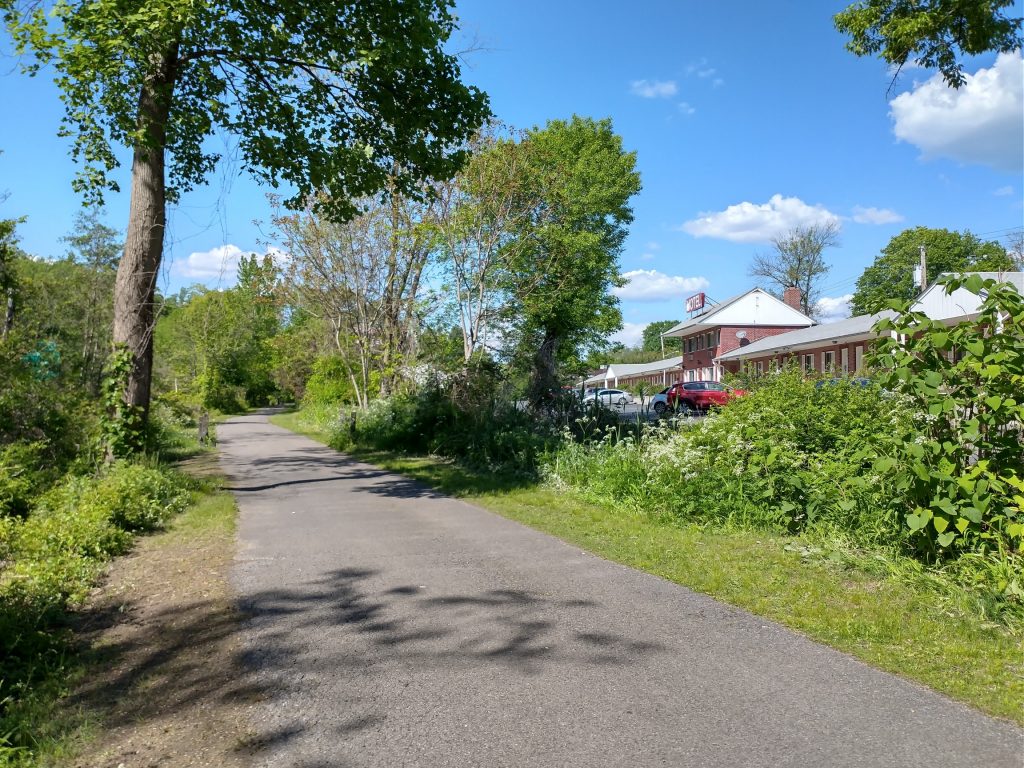
The Empire Trail passes the Ardsley Acres Hotel Court
You may have heard of “inn to inn” walks. It’s like backpacking, but with restaurant meals, beds and showers every night. I’ve heard about it in Europe, particularly in England. In California, Tom Courtney and his daughter Emily have published a series of books detailing inn to inn itineraries.
Some inn to inn walks are offered as packages by travel agents, and even include a service where you can pack more than you can carry. While you’re walking you only carry what you need for the day, and somebody will drive all the rest of your stuff to the next inn.
That’s kind of a cop-out, but at least you do all the walking yourself. One of the services here in the United States relies on a “morning shuttle” for each leg of the trip. I’m sorry, if someone’s driving you partway, you’re not hiking inn to inn. But that’s not as bad as the one that says with a straight face, “you’ll need a car to participate in the included innkeeper-assisted shuttling service for your inn to inn trip.” Just nope.
Still, it may be a while before my wife and I have the time and money to fly to Europe for a trip like this, and with international travel disrupted due to the COVID-19 pandemic, I got to thinking about possible inn to inn walks near our home in New York City.
Years ago I read Christopher Wren’s Walking to Vermont. When Wren retired from the New York Times to teach at Dartmouth College in 2003, he decided to walk from his old apartment in Manhattan to his new house in Vermont. He had a great time on the Appalachian Trail and the Long Path in Vermont, but the part of his trip through northern Westchester and Putnam counties was pretty unpleasant, walking between strip malls and speeding cars on Route 22.
Wren’s account didn’t leave me with a lot of hope. But then the State of New York opened the Empire Trail. I was skeptical about how usable it would be, but it turns out that over the past few years the New York State Department of Transportation has been actively pouring asphalt, and there’s now a continuous walkable path from Whitehall Terminal in Manhattan to a spot on Route 32 that’s about a mile south of the nearest sidewalk in Kingston.
Some of the trail incorporates existing trails maintained by other entities. I’ve already spent many hours walking and cycling on the Wallkill Valley Rail-Trail in Rosendale and New Paltz, the Hudson River Greenway in Manhattan, and the trails built on the old New York and Putnam Railroad in the Bronx, Westchester and Putnam counties.
Adding up the estimated trip times given on the Empire Trail website, it would take 40-65 hours to walk from the Battery to Kingston. If we assume eight-hour days, that’s five to eight days’ walking. You could just do it as day trips, accessing each trailhead by train or bus, and I’ve already done that from the Battery to Elmsford.
Even as I was planning day trips, I remembered that I’d seen hotels and motels from the Putnam Trail. I thought about inn to inn walks, and realized that you could do at least some of the trail this way.
Look for some more posts from me this summer about inn to inn walks, potential and actual. And let me know if you take an inn to inn walk in North America!
I have a confession to make, and it’s something I feel terrible about. I was prepared to let hundreds of thousands of people die of COVID-19.
The stores on my block were shuttered in March.
In March I was prepared to go right back to work after a mysterious fever that ran through my family for a few days, and keep going in to the office for the rest of the year. I was prepared to continue eating in restaurants, drinking in bars, sleeping in hotels, shaking hands and hugging people right through the pandemic, without masks or social distance, even as people around me were dying.
I was prepared to lose a friend to the disease, since they say the mortality rate is about one percent. I was prepared to lose my mother, my sister, my wife, my child, even to die myself.
I was prepared to carry on through the deaths as though nothing was happening, but then all of a sudden we weren’t carrying on. I got an email that we’d be working from home for a week, and then the rest of the month, then the rest of the semester, and now the rest of the year. I heard the mayor and the governor announce that restaurants, hotels, shops would be closed. I got the orders to wash hands, keep social distance, wear masks. I guess we’re doing this then, I thought.
My first face covering, April 2020
I was prepared for everyone to march on without caring for the dying because I’ve tried to buck trends before. I’ve been the only boy in the class who cried, the only kid who didn’t say the “under god” part in the Pledge of Allegiance, the only person in my social circle who didn’t own a car.
I knew that these kinds of anti-pandemic measures require widespread participation to be effective, and I knew how hard it is to get that participation. I’ve tried to organize people to make relatively modest changes, and I’ve seen the resistance that people can summon to even the most minor inconvenience. I had little hope that things would change.
But things did change, and I changed to go along with it. I worked from home, organized Zoom get-togethers, did karaoke over Twitch, avoided going shopping, ordered takeout from restaurants and cancelled travel plans. And I started wearing a mask, keeping distance from others and washing my hands more frequently. Since we got past the curve and started “reopening” I’ve gotten together with friends, but stayed outside, kept my mask on and avoided physical contact.
My work-from-home setup
Still, sometimes I think back to things I said back in February and March, and remember how I was prepared to change nothing. I’m not happy about that. I’d like to think that I’m the kind of person who always tries to do the right thing. But what is the right thing for one person to do, when the right thing requires widespread collective action, and that one person doesn’t have the power to compel collective action?
I didn’t have much power, but I discovered that other people did. My department head had the authority to order us to work from home. Our mayor and governor and state legislature had the authority to order offices and restaurants and shops closed, and to impose curfews, and to require mask-wearing. We had the power to resist to some degree, but there has been a lot of compliance. Congress and the President passed appropriations to essentially pay people to stay home.
Over the past several months I’ve learned that we already had traditions of social distance, lockdowns and mask wearing that have been used in past pandemics over the centuries. Why do so many histories focus on innovations in science (germ theory, mosquitoes) and technology (sewers, drainage, vaccines), and on How Stupid People Were Back Then (theories like miasma and night air, and the infamous 1918 Philadelpia victory parade), and not on masks, lockdowns and outdoor dining?
A visit to my deserted office in July
A lot of the shutdown of offices, shops and restaurants was facilitated by the widespread adoption of remote work, online learning and delivery of all kinds of objects, including food and medicine. These practices in turn have been prepared and encouraged by employers, college administrators and the owners of delivery companies, and to some degree by employees, students and shoppers, out of a belief that they are cheaper and more convenient. It’s not obvious to me that that belief is well-founded, but if it weren’t widespread, would there have been as much compliance with the lockdowns?
I was impressed at the amount of influence certain people wielded at particular points. The early injunctions to more frequent and thorough hand-washing, along with catchy two-minute pop-culture songs to hum and mantras to recite (remember “Fear is the mind-killer”?) while washing drew people in and functioned as a kind of structure test. Viral posts about flattening the curve helped to convince people that behavioral changes were urgent but temporary. Influential people who set an example on the street and on social media allowed some of us to feel comfortable adopting practices like face masks that had been seen as foreign.
Of course, people can also withhold their power to compel and encourage collective action. The most tragic example is that of Bill de Blasio and Andrew Cuomo, who could have saved tens of thousands of lives by giving shutdown orders a week earlier, but held back for whatever reasons. Donald Trump and his followers in the Republican Party, including Mitch McConnell and Lachlan Murdoch, have ended the unemployment and stimulus payments, and shockingly turned practices that could save thousands of lives into badges of political allegiance.
Some of these negative practices appear to have been motivated by a thirst for power on the part of people like Cuomo and Trump. Some stem from a fear that generous unemployment and stimulus benefits could lead people to ask why we don’t provide those benefits all the time. Others are driven by the news that those most at risk from the coronavirus are the same people that our society already takes advantage of — Black and Latinx people, American Indians, immigrants and poor people — and a reluctance to do anything that might disproportionally benefit them.
Fresh graves, New Calvary Cemetery, May 2020
It worries me a lot to realize how much of our ability to act in moral ways is constrained by the power of others. Especially by people who have amassed power for the sake of power, or out of greed, like our current leaders. It saddens me to see how I’ve learned to have such low expectations of our leaders. And how some of them haven’t even risen to those low expectations.
This is the first in a series of posts about COVID-19. Here is the second, and here is the most recent.
I originally published this on Medium. I haven’t been very happy with Medium recently, so I’ve started moving some of my posts from there to this blog.
In the summer of 1998 I was on a bus from Montreal to New York. At the United States border we were told to get off, get our bags and file through a building. Inside I showed an immigration agent my passport, or maybe my driver’s license.
“Why’d you go to Canada?” “For a conference.” “What kind of conference?” “A conference on computational linguistics.” “So you’re a computer programmer?” “Sort of, I’m-“ “Why’d you go to Canada?” “For a conf-“ “Okay, bye-bye.” “Huh?” “Bye. Go on.”
It’s hard for me to put into words exactly what bothered me about this exchange. It always upsets me to be interrupted, dismissed and silenced, but this particular instance has stayed with me over almost 21 years.
The logical incoherence of the conversation bothered me at first. The agent clearly understood my first answer, and he couldn’t have forgotten it so quickly, so why did he ask again? And then why didn’t he wait for me to answer again?
A few years later, someone told me that a common technique in psychological screenings is to ask the same question multiple times. If someone gives inconsistent answers, that suggests that they’re lying or otherwise unreliable. My best guess is that this immigration agent was trying to catch me in a lie.
If that’s what he was doing, he was really inept at it. That technique depends on the subject refreshing their short term memory, which requires more intervening conversation and a change of topic. It simply wasn’t possible for him to deploy that technique effectively while keeping the line moving, but he didn’t realize that.
That bungled interrogation tactic was disorienting, but the agent could have reassured me with a few words, or even a smile. Instead, he compounded his manipulation with dismissiveness and contempt.
As I walked away from the desk, I was struck by the brutality of the interaction, at the feeling of being in the hands of someone who saw me as less than human. I could have protested, but I had heard stories. They could have found some reason to question me, hold me in the middle of nowhere until after my bus left, until after the last bus left.
Of course I was not physically harmed in any way. I wasn’t detained or prevented from boarding my bus. I was not even insulted or threatened. It feels weird to even talk about my experience in light of the much worse abuses that so many people have suffered under the Border Patrol over the years, especially since Donald Trump became President.
Somehow, it feels relevant. The casual nature of the brutality, even just in the tone, that that Border Patrol officer felt comfortable using in a routine interrogation of someone he saw as a privileged (but bus-riding) white male citizen who wasn’t challenging his power at all made me imagine what he and his colleagues were capable of with people who don’t look like middle-class white guys and don’t have citizenship papers.
I wrote most of this post last year, after reading articles about rank-and-file border patrol officers expressing satisfaction that they’d been “unshackled” by Trump, but I didnt finish it. Today, when the Acting Commissioner of the Border Patrol announced that they were being deployed to the District of Columbia (which hasn’t had a border since 1861) I remembered that incident in 1998, and felt I should share my story.
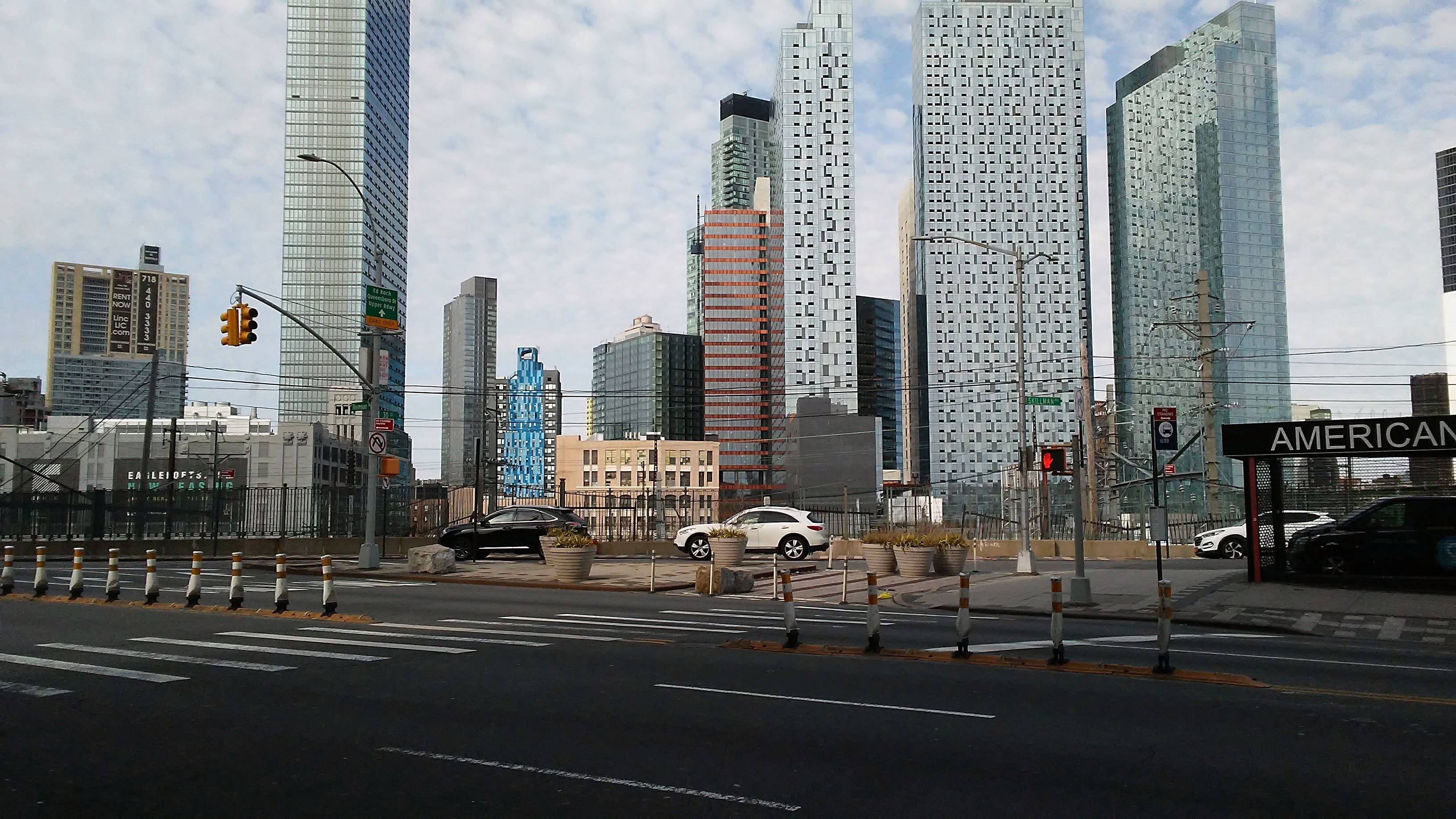
Mayor de Blasio, the CEO of Amtrak, and the leadership of the Queens Chamber of Commerce want to build a series of decks over the Sunnyside Yards, that would then serve as platforms for new apartments, offices and possibly parks and attractions. Some of my neighbors have expressed opposition on various grounds, and have tried to recruit me to join them.
When I was first approached, I was sympathetic, and there is still one very good reason the city shouldn’t build these decks: they’re not worth it. Decking advocates claim that the project will allow new affordable housing, bring in more tax revenue and connect Sunnyside more closely with Long Island City. Those are nice, but we can get them all without spending billions of taxpayer dollars on decks.
We can get more housing and bring in more tax revenue by rezoning our miles of single-family and attached house zones to allow for new apartments, and building new trains to connect these neighborhoods to Manhattan. Modern, quiet elevated trains like those in Vancouver cost a fraction of what we spent on the Second Avenue Subway.
To the extent Sunnyside feels disconnected from Long Island City and Astoria, it’s because the bridges over the Yards are noisy and feel unsafe. They are desolate at night, and filled with speeding cars at most hours. Shops and homes along the route would make them feel safer, but that doesn’t require giant decks; it could be done by doubling the widths of the bridges.
The noise of the 7 train could be mitigated by extending the concrete cladding that shields us from the tracks in Sunnyside. The noise of the roadway could be mitigated by removing the large metal barriers that reflect noise back onto the sidewalks and replacing them with fences. These are expensive projects, but much less expensive than building giant decks.
I oppose the decking proposals on these fiscal grounds. I do not object to them on any of the other grounds that my neighbors assert without evidence. I do not believe that they would contribute to displacement or overcrowding in our existing buildings; if anything, the added supply would probably give us more room and bring rents down.
I also disagree with the claims by some of my neighbors claim that new buildings on the decks would add to construction noise, dust or car traffic, or significantly increase crowding on the 7 train. I do not agree with the claim by one of my neighbors that these decks will result in a net increase in carbon emissions and heat simply by containing buildings.
These decks are not a worthwhile use of our tax dollars. If private investors are willing to pay for these decks, I have no reason to oppose them. I would much rather see the money spent on new subways, and the housing achieved by upzoning.
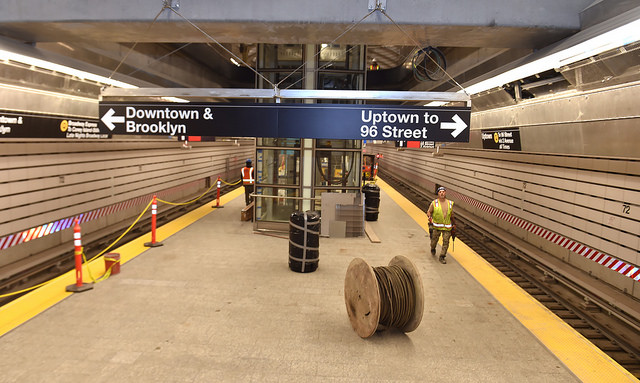
In 1956 Isaac Asimov wrote a little song about the Second Avenue Subway, set to the tune of a classic Christmas carol. Fifteen years later he published it in his Treasury of Humor. I’ll let you follow the link and read it, because I don’t want to spoil the joke.
I totally want to sing this song at the opening ceremonies. Who’s with me?
Today I took a walk along Queens Boulevard in my neighborhood, where the Department of Transportation has been working to transform the medians into walking and cycling paths like those on Eastern and Ocean Parkways in Brooklyn. One of the most interesting changes is the closing of the “slip lanes” which allowed drivers to switch from the express to the local lanes and back. The slip lanes between 54th and 56th Streets are already closed (see above).
Back in January I attended a DOT revisioning workshop for the Boulevard. We packed the cafeteria at my son’s old elementary school, and in a very encouraging contrast to a similar meeting in 2003, everyone seemed to agree that we need to do something. Peter Beadle, a fellow pedestrian advocate who lives down the Boulevard in Rego Park, focused on the slip lanes when reporting his table’s recommendations. After the meeting, he pointed out to me that Ocean and Eastern Parkways in Brooklyn have no slip lanes, which is a major factor in why they feel so much safer than avenues that are otherwise similarly designed, like Queens, Woodhaven and Linden Boulevards and the Grand Concourse. Here is a slip lane on Queens Boulevard that has not been closed, between 58th and 59th Streets:
Reviewing the presentation that the DOT gave to Community Board 2, it looks like they are not planning to close this slip lane. Instead, they will make it safer by putting a stop sign in the middle of it. Knowing how cavalierly drivers treat other stop signs, I’m skeptical about this, but it will be an improvement over the current slip lanes.
Diagram: NYC DOT
More importantly, it will allow for a continuous pedestrian path alongside the bike path on this entire stretch of Queens Boulevard. This afternoon I walked from 51st to 58th Streets on this path, and because there was only one lane of moving vehicles to my right it felt relatively safe. Once this path is continued all the way to 63rd Street (and hopefully beyond, one day), I think it will become a popular stroll, like the paths on Ocean and Eastern Parkways are now. The DOT has already painted crosswalks and put up signals for pedestrians:
(If you zoom in on this picture, you can see that the last car that went through here was doing 38 in a 25 mile an hour zone. We’ve got a lot more work to do.)
Banning diesel vehicles, partially pedestrianizing the four central districts, bike paths, routes dedicated to “environmentally friendly” vehicles… The Mayor of Paris seems to have realized the danger that air pollution poses to people who spend time in the Paris region, whether they live there or not (details here).
These steps, which will be debated at upcoming City Council meetings, will be attacked by various lobbies and may become a political football. Anne Hidalgo knows a thing or two about that. Her Tour Triangle project was defeated last november by an ad hoc coalition in the chamber. The next round of residential parking rate increases, which the administration is quietly promoting, is still being debated by the ruling coalition. City Hall is worried that the Communist city council members will refuse to touch it, perceiving it as an attack on low-income households.
Discouraged pedestrians. So to bring down pollution, but also noise and frustration, while easing commutes, what if we started by widening the sidewalks? When you think about the street space available, when we encourage one mode of transportation, in this case walking, we discourage the others. Take a look at the photo above. To cross the intersection you’d be better off on a motorcycle than trying on foot. Pedestrians deserve better: according to a study by Insee, half of all trips in the capital are made on foot.
A little strip of asphalt. In small streets, a sliver barely a meter wide is left for pedestrians, whether they’re traveling solo, with others, with a stroller, in a wheelchair, or pulling a suitcase. The lane is wide enough that a speeding car or motorcyle can terrorize passersby, sending them running for their little strip of asphalt.
King Bollard. Bollards, metal ones in particular, are installed to prevent sidewalk parking, but wind up limiting the movement of pedestrians. But that’s not all: green trash cans, angle-parked motorcycles, café tables and chairs, loose trash, yellow trash cans, and so on. There’s a lot going on on a Parisian sidewalk.
All it takes is one irritant. In a lot of our streets, particularly at certain times of day, pedestrians have no choice but to walk in the street. This is not always dangerous, because drivers slow down automatically, but it’s inconvenient for everyone. A single car on a quasi-pedestrian street can upset fifty pedestrians, just like a single train passenger yelling into a cell phone at the expense of everyone else’s peace and quiet.
Like a racetrack. For pedestrians it is impossible to cross certain intersections in one light, thanks to barriers placed by the city. What you see in the photo above sends the message: Streets are sacred, like a racetrack, no trespassing. When we install these protections we forget that people who move with their bodies like to move fast too. If we freed pedestrians from the confines of these sidewalks we would at the same time cut down on the speed of cars, and eventually on unnecessary car use.
Let’s talk business. On the Grands Boulevards, in many places, there is still a lane across the sidewalk to allow drivers to access the parking areas. Sure they do it slowly, but they push pedestrians aside, behind bollards. And this hurts businesses! Despite what you may hear from developers, and even from some business people, the best customers for local businesses are pedestrians and cyclists. They may buy less per visit, but they shop more often – as long as they feel comfortable on the street.
Sidewalks erased. Sometimes when people are doing construction they will close the sidewalk, but not the bike lane. You might think they do it on purpose, to set up the kinds of conflicts so beloved by the tabloids. This might be a good place to note that in calmer cities dedicated bicycle infrastructure is no longer necessary: bikes ride in the street, leaving plenty of space on the sidewalk for pedestrians.
That pointless barricade. Sometimes we just can’t figure out the rationale behind certain installations. In the above photo, at the exit of the Colonel-Fabien metro station, this little barricade obstructs the flow of people leaving the metro and waiting to cross the street. What is the point of this piece of steel? There must once have been one, but it has been forgotten by everyone, including the transportation department.
On the evening of September 28, 2013, college student Luis Bravo was killed by a hit-and-run driver in my neighborhood while walking down Broadway on the way home from the supermarket. As I wrote a few days later, that part of Broadway is too broad, and has always felt dangerous to me. I asked for the roadway to be narrowed from four lanes to two, and the width given to expanding the sidewalks.
At the request of our City Council member, Jimmy Van Bramer, and other community leaders, the Department of Transportation studied the road and determined that we do not need four lanes there. Just this week they repainted it, transferring that width to a painted median and extra-wide parking lanes. Compare the above picture that I took today with one that I took last year, from just a block further west:
At 5:30, the height of rush hour, there was no gridlock, no cars backed up for more than half a block, and many gaps in between platoons of cars. The cars were moving steadily, but slower than before. There were also several bike commuters taking advantage of the extra-wide parking lanes, as you can see in the photo below (at the corner where Bravo was killed):
I haven’t ridden a bike on this section, so I don’t know how safe the parking lanes feel, but I still would rather see wider sidewalks than these painted medians and turn lanes. The real test, as my neighbor Al Volpe wrote to the Woodside Herald, is whether the paint will slow down cars at 11PM. If it does, we may well have saved others from Luis Bravo’s fate.
This past Saturday, a young college student was killed by a hit-and-run driver while walking on Broadway at 58th Street here in Woodside. I know the danger he felt. Just two weeks before I was walking home from a dinner date in Jackson Heights. At 59th Street, a block before the corner where Luis Bravo was killed, I said to my wife, “Let’s turn here. This stretch of Broadway always feels dangerous to me.”
The width of this stretch of Broadway is puzzling. It’s a strange gap: years ago, before I moved to Queens, I walked most of the length of Broadway, from Elmhurst to Astoria, and this area almost made me regret my trip. A few blocks east, at 63rd Street, it’s seventy feet wide. A few blocks west, at 53rd Place, it’s also seventy feet wide. Between those two streets, the road widens to ninety feet, and from two travel lanes to four.
Maybe the people digging the subway needed a ditch that wide because the local and express tracks come together at Northern Boulevard. Maybe the city engineers thought that Broadway needed to be four lanes wide to bring cars from 34th and 35th Avenues to Northern Boulevard. If so, they were wrong. There is never a traffic jam on those blocks, even in the height of rush hour. There’s lots of room for the cars, which encourages drivers to speed.
We have already looked into ways to make this area safer. My City Council Member, Jimmy Van Bramer told Streetsblog that earlier this year, at the request of my neighbor Ed Surmenian, his staff asked the City Department of Transportation to study changing the timing of the traffic signals. The DOT responded that the signals were properly timed.
Stephen Miller of Streetsblog tells us that the DOT has proposed “road diets” for similarly overbuilt streets like Morningside Avenue, to take space away from cars. The Morningside Avenue proposed configuration would certainly be an improvement over what we have, but it would just waste that space on painted medians.
The sidewalks on Broadway should be widened, giving that space to pedestrians. The sidewalks on the south side are relatively comfortable, varying from ten to fifteen feet wide, but the ones on the north side are all under ten feet wide. The sidewalks on both sides should be a minimum of twenty feet wide.
You may say that you don’t see that many people walking on that part of Broadway, so why have twenty foot sidewalks? I say that people don’t walk because they don’t feel safe, just like my wife and I turned off when we got to 59th Street. With wider sidewalks and slower cars, more people will walk. It’s a natural connection between Jackson Heights and Astoria, after all.
Another thing that would bring people to walk in that area would be interesting stores and restaurants, but the zoning doesn’t encourage it. West of 63rd Street the avenue is zoned for residential construction, and west of 57th Street it’s manufacturing, but there’s very little manufacturing on Broadway itself. A C2-5 commercial overlay would allow people to build stores along Broadway in this section that look just like the ones west of 49th Street and east of 72nd Street.
I know that Jimmy Van Bramer and his staff have been working hard to make the district safer to walk in. I know that Borough Commissioner Maura McCarthy wants pedestrians to be safer in Queens. So let’s take away those extra lanes of Broadway and make the sidewalks wider. And let’s bring in the Department of City Planning and make it legal to build stores and restaurants right up to the sidewalk. Let’s make this part of Broadway a place where people can stroll in comfort.





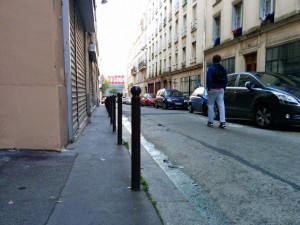 Banning diesel vehicles, partially pedestrianizing the four central districts, bike paths, routes dedicated to “environmentally friendly” vehicles… The Mayor of Paris seems to have realized the danger that air pollution poses to people who spend time in the Paris region, whether they live there or not (details here).
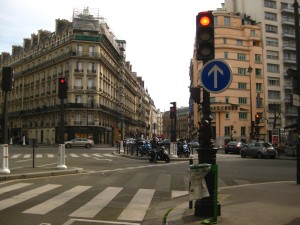 Discouraged pedestrians. So to bring down pollution, but also noise and frustration, while easing commutes, what if we started by widening the sidewalks? When you think about the street space available, when we encourage one mode of transportation, in this case walking, we discourage the others. Take a look at the photo above. To cross the intersection you’d be better off on a motorcycle than trying on foot. Pedestrians deserve better: according to a study by Insee, half of all trips in the capital are made on foot.
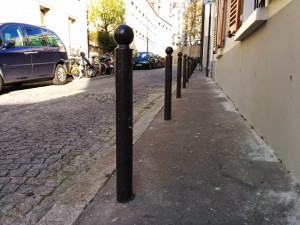 A little strip of asphalt. In small streets, a sliver barely a meter wide is left for pedestrians, whether they’re traveling solo, with others, with a stroller, in a wheelchair, or pulling a suitcase. The lane is wide enough that a speeding car or motorcyle can terrorize passersby, sending them running for their little strip of asphalt.
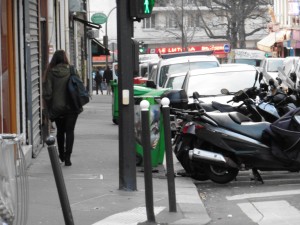 King Bollard. Bollards, metal ones in particular, are installed to prevent sidewalk parking, but wind up limiting the movement of pedestrians. But that’s not all: green trash cans, angle-parked motorcycles, café tables and chairs, loose trash, yellow trash cans, and so on. There’s a lot going on on a Parisian sidewalk.
 All it takes is one irritant. In a lot of our streets, particularly at certain times of day, pedestrians have no choice but to walk in the street. This is not always dangerous, because drivers slow down automatically, but it’s inconvenient for everyone. A single car on a quasi-pedestrian street can upset fifty pedestrians, just like a single train passenger yelling into a cell phone at the expense of everyone else’s peace and quiet.
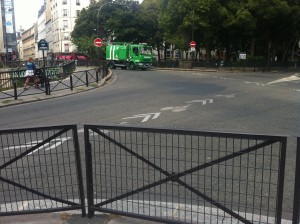 Like a racetrack. For pedestrians it is impossible to cross certain intersections in one light, thanks to barriers placed by the city. What you see in the photo above sends the message: Streets are sacred, like a racetrack, no trespassing. When we install these protections we forget that people who move with their bodies like to move fast too. If we freed pedestrians from the confines of these sidewalks we would at the same time cut down on the speed of cars, and eventually on unnecessary car use.
 Let’s talk business. On the Grands Boulevards, in many places, there is still a lane across the sidewalk to allow drivers to access the parking areas. Sure they do it slowly, but they push pedestrians aside, behind bollards. And this hurts businesses! Despite what you may hear from developers, and even from some business people, the best customers for local businesses are pedestrians and cyclists. They may buy less per visit, but they shop more often – as long as they feel comfortable on the street.
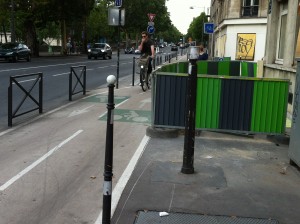 Sidewalks erased. Sometimes when people are doing construction they will close the sidewalk, but not the bike lane. You might think they do it on purpose, to set up the kinds of conflicts so beloved by the tabloids. This might be a good place to note that in calmer cities dedicated bicycle infrastructure is no longer necessary: bikes ride in the street, leaving plenty of space on the sidewalk for pedestrians.
 That pointless barricade. Sometimes we just can’t figure out the rationale behind certain installations. In the above photo, at the exit of the Colonel-Fabien metro station, this little barricade obstructs the flow of people leaving the metro and waiting to cross the street. What is the point of this piece of steel? There must once have been one, but it has been forgotten by everyone, including the transportation department.